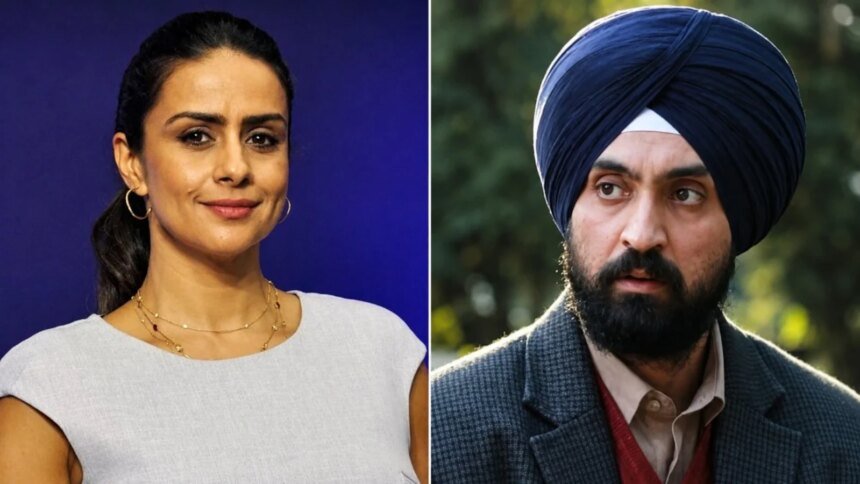
The controversy surrounding Satluj refuses to die down. The film, set against the backdrop of Punjab’s militancy years, was removed from ZEE5 just two days after its release in India, triggering a wider conversation around censorship, artistic freedom and who gets to tell Punjab’s story.
In an exclusive interview with NDTV, actor Gul Panag has now weighed in on the debate, arguing that the conversation extends far beyond one film. Drawing from her own memories of growing up in Punjab during the years of militancy, Panag said the state’s rejection of separatism is neither recent nor fragile, and warned against banning films that deal with uncomfortable chapters of history.
‘Punjab Is Forced To Defend Its Patriotism’
Explaining why she chose to speak out now, Panag said the issue was never really about Satluj itself.
She said, “I feel that, as someone from Punjab, every now and then Punjab is forced to defend its patriotism and nationalism. This is despite Punjabis having served the country in uniform, in public life, and in countless other ways before, during and after the terrorism period. Our rejection of separatism has been unequivocal and rooted in the democratic process and the Constitution of India. Yet, every now and then, there is reason to second-guess what the people of Punjab feel or think.”
She added that the film was merely incidental to a much larger discussion.
“That is why I wanted to speak. For me, this is not about a film. The film is incidental. Why shouldn’t we confront difficult chapters of our history as a mature democracy? We should be able to have these conversations, especially when Punjab has unequivocally rejected separatism.”
‘History Needs Debate, Not Silence’
Speaking about growing up during Punjab’s most turbulent years, Panag said history should never be viewed as a fixed narrative.
She shared, “History is always viewed through a perspective. Increasingly, we’re becoming aware that history was taught to us from a certain perspective, and now there are efforts to change that perspective. The truth lies somewhere in the middle, and every individual must draw their own conclusions. Those conclusions can only be drawn through discussion, dialogue and debate. You have to disagree with me for me to open my mind to something I may not have considered.”
She stressed that conversations around difficult periods are essential for reconciliation.
She added, “Conversations about difficult times are important because they help in healing, but more importantly, they help in reconciliation. South Africa had a Truth and Reconciliation Commission. We haven’t had any comparable reconciliation effort for the darker chapters of our own history. Punjab paid a terrible price for terrorism. Innocent Hindus were killed. Innocent Sikhs were killed. Security forces paid a heavy price. These conversations are necessary so that the constitutional principles we uphold remain at the forefront and we never regress to what we’ve come out of.”
‘We Undermine Punjabis By Thinking A Film Can Change Them’
Panag also dismissed the suggestion that a film could alter Punjab’s political or social convictions.
“Absolutely. I can speak for the Punjab electorate, which has repeatedly rejected separatism through the ballot. There has never been a lasting mandate for any separatist movement, barring the 1989 Lok Sabha election, and even that was a passing phase. Punjab has moved on. Punjab’s contribution to the nation, including in uniform, continues even today. The number of soldiers from Punjab who make the ultimate sacrifice is testament to that. So why all this noise? We undermine the collective wisdom of Punjabis by believing that a film can change that.”
‘Bans Are Always Counterproductive’
On the decision to remove Satluj from streaming, Panag said censorship often achieves the opposite of its intended purpose.
“I think bans are always counterproductive. First, they increase curiosity. People who may otherwise have ignored the film will now want to watch it. The film is in Hindi, so it wasn’t necessarily going to be consumed widely in Punjab. But the ban has made people curious.”
She also argued that banning a film inevitably turns it into a political issue.
“Second, a ban politicises the film. It opens the door for political parties to exploit it. We’ve already seen reactions where people have decided to publicly screen the film. That is exactly what happens when something is banned.”
‘The Conversation Has Very Little Resonance On The Ground’
Addressing concerns that Satluj could romanticise separatism, Panag maintained that Punjab’s electoral history tells a different story.
She said, “Punjab has unequivocally rejected separatism. The record speaks for itself. There may be fears that certain people could be emboldened, but those fears are amplified on social media, in television studios and sometimes by sections of the diaspora. There are people who sought political asylum abroad and have their own reasons to continue certain narratives. But on the ground, that conversation has very little resonance. Punjab has repeatedly rejected separatism within the constitutional framework. I don’t understand this obsession with second-guessing the people of Punjab.”
‘Both Sides Of Punjab’s Pain Must Be Remembered’
Panag also spoke about why every aspect of Punjab’s suffering deserves acknowledgement.
She shared, “When you share stories from both sides, you realise the pain is common. It doesn’t diminish anyone’s suffering. I was old enough to read newspapers during those years. I read about children, women and men being killed because they were Hindus. That was painful, regardless of the fact that I’m Sikh.”
She continued, “There were innocent Sikhs who were killed for opposing terrorism. There were people in isolated villages who had armed men arriving at their homes asking for food or money. There were innocent young men who were picked up. There were extrajudicial processes. There were innocent Hindus who lost their lives. There were innocent Sikhs who suffered. All of these realities deserve acknowledgement.”
‘This Was Personal For My Family Too’
Reflecting on her own family’s experience, Panag said the violence touched even those who were not directly targeted.
“It was. I know many such cases personally. In my village, people were picked up. My grandfather was the village panch, so he was deeply involved in helping families. Eventually, my grandparents had to leave the village and move to Chandigarh because it had become a security concern for them as well.”
She added, “We were fortunate that our immediate family did not suffer the kind of tragedy many others did, but even members of my extended family were picked up for questioning and detained during the militancy period. The fact that innocent people were picked up and due process wasn’t always followed is something we cannot ignore. Even CBI inquiries have acknowledged that.”
‘Punjab Has Already Moved On’
According to Panag, Punjab’s resilience has already been demonstrated over decades.
“Absolutely. If one state has demonstrated resilience since Partition, it’s Punjab. It faced Partition, repeated invasions in history and the terrorism of the 1980s and 1990s. Yet the people rejected separatism. The question is: when will the rest of the country move on? Look at the electoral outcomes over the last three decades.”
On concerns over Khalistani elements, she said, “There have always been fringe groups with particular beliefs. That exists in every state. The real question is whether those groups are politically, electorally, economically or socially significant. They aren’t. Panthic politics will always exist, but the people of Punjab are smarter than that. They’ve demonstrated that repeatedly since 1997.”
She further argued that much of the controversy exists outside the state itself.
“The controversy is largely outside Punjab and in television studios. It isn’t within Punjab. There will always be people who aspire to certain ideas, but are they significant enough to derail Punjab’s rejection of separatism? No. Stable governments and electoral mandates over the last 30 years prove that.”
‘The Constitution Must Be The Lens’
While clarifying that she was not defending Satluj as a film, Panag said difficult chapters should be examined through constitutional principles.
“I’m not the filmmaker, and I’m not here to defend the film. I’m here to defend Punjab. Punjab has moved on. Because it has rejected separatism within the constitutional framework, it’s important that we examine difficult chapters through that same constitutional framework.”
She added, “The film reportedly deals with extrajudicial killings, which CBI reports have also examined. Whether specific numbers are accurate or not, it is important to confront that part of our history through a constitutional lens. In a constitutional democracy, the monopoly over coercive power rests with the state, and the use of that power must always be accountable.”
Expanding on that point, Panag said, “Let’s look at it through the constitutional lens. In a constitutional republic and a constitutional democracy, the monopoly over the coercive power of the state lies with the state. The use of that coercive power has to come with responsibility, due process, the rule of law, and adherence to the Constitution of India.”
“That is an important conversation to have today because if we don’t have it, we avoid the uncomfortable parts of our history that we must revisit. We need to acknowledge that Hindus and Sikhs both paid the price of terrorism. At the same time, we also have to confront the uncomfortable reality of how judicial and extrajudicial processes became intertwined. Those cannot become governing principles, and there can be no defence of them under any circumstances.”
‘Punjab’s People Will Write Punjab’s Story’
Concluding her remarks, Panag said no film could define Punjab’s legacy.
“The people of Punjab have already written Punjab’s story. They have written it electorally, within the principles enshrined in the Constitution of India, and they continue to tell that story. Any other story doesn’t matter.”
She added, “A film is just one perspective. It is an individual’s perspective and it will always have a particular lens. Every film-whether it’s The Kashmir Files, The Kerala Story, or Satluj-is made through a specific lens. They are not writing history textbooks. Even historians have their own lenses, as we’ve seen very clearly. History itself is coloured by perspective.”
“Ultimately, Punjab’s people will write Punjab’s story. They’ve done so by continuing to serve the country, by continuing to uphold the Constitution, and by continuing to reject separatism in no uncertain terms. They alone will write Punjab’s history,” she concluded.