


Published On 7/8/2026
|
Last update: 7/9/2026 11:28 (Mecca time)
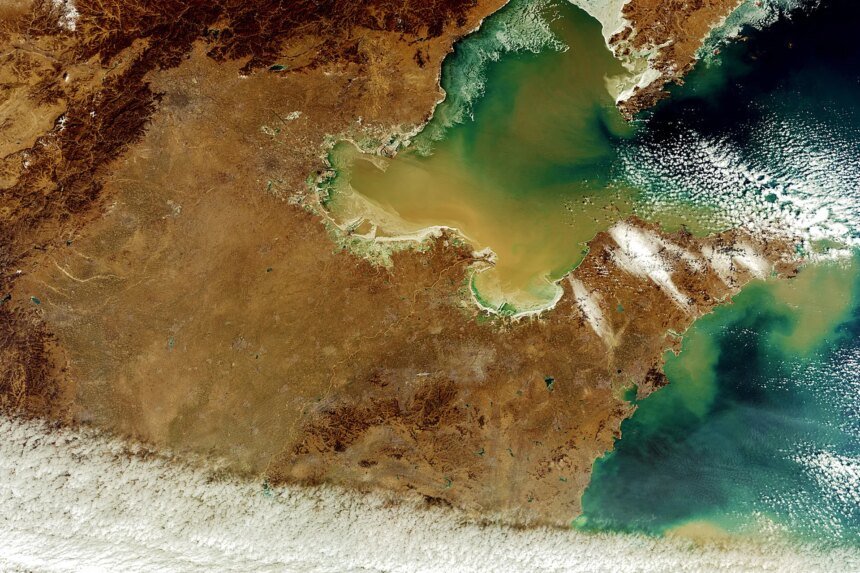
A sea located in the northwestern Pacific Ocean, separating China from the Korean Peninsula. It gained its name from the golden-yellow color that its waters acquired due to clay sediments carried by Chinese rivers, in addition to fine sand from the Gobi Desert.
It is considered one of the most important economic and environmental seas in East Asia, as it is distinguished by its rich fish and oil resources. It constitutes a major corridor for maritime trade and is home to a rich biodiversity, but it faces increasing challenges due to pollution, overfishing, and environmental changes.
Location and naming
The Yellow Sea is located in the northwestern part of the Pacific Ocean, separating mainland China from the Korean Peninsula. It is bordered to the north by the Bohai Gulf, to the west by the eastern coasts of China, to the east by the coasts of North and South Korea, while to the south it is connected to the East China Sea via the Korea Strait.
The sea gained its name from the golden yellow color that characterizes its waters, as a result of the large quantities of clay sediments (silt) carried by the rivers, especially the Yellow River (Huang He), in addition to sand particles transported by the winds from the Gobi Desert, giving its waters its yellowish color.
It is known in China as Huang Hai, while in the two Koreas it is called the “West Sea” due to its location west of the Korean Peninsula.

Geography and climate
Its area is about 380 thousand square kilometers, and it is a very shallow sea with an average depth of only 44 metres, while its maximum depth reaches about 152 metres. Several rivers flow into it, most notably the Yellow River, Yangtze River, Yalu River, and Han River.
Its climate is characterized by a moderate seasonality, with cold, dry winters during which ice sheets form in its northern parts, while summers are warm and humid, with the region becoming more likely to be exposed to tropical cyclones in the period between June and October.
Biodiversity
The Yellow Sea is characterized by a rich biodiversity, as it includes more than 200 species of fish, most notably cod, Japanese mackerel, and herring, in addition to large numbers of molluscs and crustaceans that form an important basis for the fish wealth in the region. Its waters also harbor a number of marine mammals, including spotted harbor seals and various types of whales.
The Yellow Sea is one of the global stations for migratory birds on the East Asia-Australia route, as millions of birds cross it annually during seasonal migration flights.
Its vast mud swamps provide natural habitats of exceptional environmental importance, parts of which have been included on the UNESCO World Heritage List because they host a number of endangered species.

Economic importance
The Yellow Sea represents one of the most important economic maritime basins in East Asia, as more than 600 million people live in its vicinity, and the countries bordering it depend for a large part of their economic activities on its marine resources.
Along with the East China Sea, it is considered one of the richest fishing areas on the Asian continent, where the fleets of China, South and North Korea, and Japan are active in investing in its fish resources.
Aquaculture and the extraction of salt from seawater constitute two important pillars of the local economy, in addition to the oil and natural gas reserves explored at its bottom, especially in the marine areas of China and North Korea.
Its commercial importance is also increasing with the growth of navigation and trade between countries overlooking it through major ports such as Dalian, Tianjin, Qingdao and Qinhuangdao in China, Incheon in South Korea, and Nampo in North Korea.
Environmental challenges
The Yellow Sea faces increasing environmental challenges, most notably overfishing, which has led to a decline in fish stocks and the depletion of many species of high economic value.
Its waters are also subject to growing pressure as a result of pollution resulting from industrial and domestic waste, sewage, oil leakage from ships, as well as the accumulation of pollutants carried by rivers.
In response to these challenges, China and a number of countries bordering the sea have taken more stringent measures to enhance the protection of the marine environment, including regulating fishing activities, reducing sources of pollution, and implementing programs aimed at restoring ecosystems and preserving biodiversity.

Studies and explorations
The Yellow Sea has received wide scientific attention in the fields of geology, marine sciences and marine biology, but many of its environmental characteristics still require further study, especially related to the state of fish stocks and the effects of human activities and climate change.
Although there are some aspects of scientific cooperation, political tensions between the countries bordering the sea since the middle of the twentieth century have limited the exchange of data and the conduct of joint studies, which has made it difficult to comprehensively assess the environmental state of the sea and develop unified regional strategies for managing and preserving its resources.