

Published On 7/8/2026
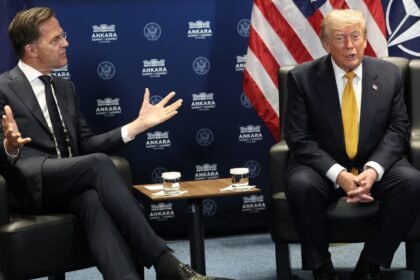
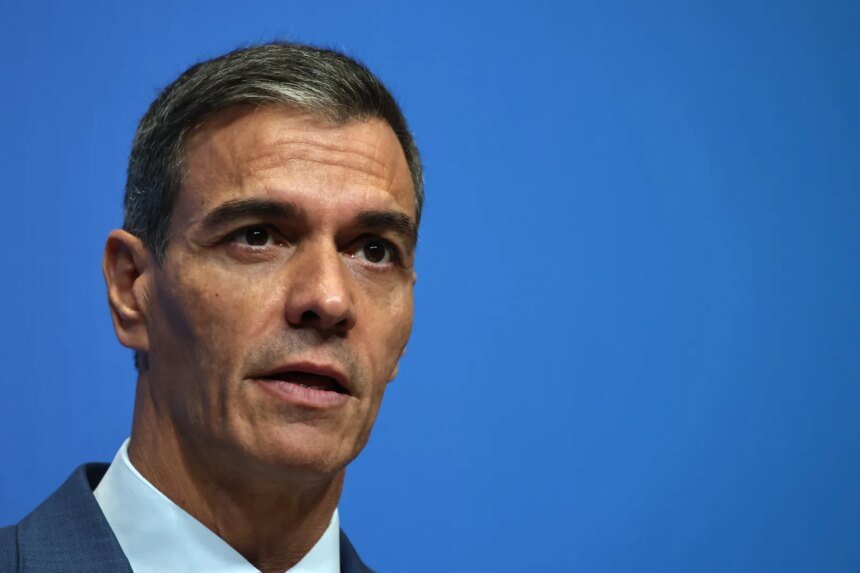
Spanish Prime Minister Pedro Sanchez revealed that his meeting with US President Donald Trump on the sidelines of the NATO summit in Ankara took place in a friendly atmosphere, stressing that their conversation was limited to the World Cup of football and golf, denying that the US President raised during the meeting his previous statements in which he described Spain as a “bad ally.”
Sanchez added, during the press conference that followed the summit, that his government is dealing with these statements “calmly and patiently,” stressing that relations between Madrid and Washington are “very positive” at the political, diplomatic and cultural levels, and that what unites the two countries is more than what divides them.
He stressed that the customs duties file with the United States remains within the jurisdiction of the European Commission, with Madrid continuing to support Brussels’ efforts to reach an agreement with Washington. He also stressed that military cooperation between the two countries is “excellent,” and that decisions related to the deployment of American forces in Europe remain an American sovereign matter, while affirming Spain’s desire to maintain the best relations with all its allies, regardless of the differences in the administrations in the White House.
In his speech before the NATO summit, Sanchez stressed that Spain had proven to be a “competent ally” within the alliance, announcing the participation of Spanish ground forces in a new mission in Finland to contribute to protecting the Arctic region, in a move that he said reflects Madrid’s commitment to European defense and participation in the alliance’s collective security system.
He explained that the Spanish Armed Forces are widely appreciated by the leaders of member states, noting that Spain is the second largest contributor to the alliance’s foreign military missions, whether in the Atlantic Ocean, Iraq, or the European Eastern Front.
He pointed out that his country increased its defense spending to more than 2% of GDP, after it was less than 1.4% when his government took power in 2018, stressing that the increase was directed towards developing the Spanish and European defense industry, enhancing investments in technology and innovation, and modernizing the armed forces, within the framework of strengthening European defense independence and sharing responsibilities among allies.
He added that NATO countries agreed during the summit to support the military industry, accelerate investment in defense technology, and remove trade barriers, noting that Spain supported these efforts through an industrial plan worth 400 million euros (about 432 million dollars).
Strengthening defense capabilities
Regarding the Ukrainian file, Sanchez said that the war represents a direct threat to the European project, stressing that during the year 2025 his country provided about one billion euros (about 1.08 billion dollars) of military equipment and aid to Kiev, in addition to training thousands of Ukrainian soldiers and officers, signing memorandums of understanding with Ukrainian companies, and participating in support programs within NATO.
He added that Spain has become the eighth largest supporter of Ukraine within the alliance, and the fifth largest European country in terms of the volume of aid provided during the year 2025, while the total bilateral aid since the outbreak of the war has reached about 3.8 billion euros (about 4.1 billion dollars), in addition to its contributions through the European Union, noting that Ukrainian President Volodymyr Zelensky has repeatedly praised Spanish support.
Sanchez stressed that his country, despite its geographical distance from the Eastern Front, Ukraine and the Middle East, adheres to the principles on which the European Union and NATO were founded, stressing that Spain is “a peaceful country, but a competent ally,” and that strengthening defense capabilities must not be at the expense of social investment.
In response to a question about proposals to raise defense spending to 5% of the gross domestic product, he said that the discussion should focus on building military capabilities gradually, and not on numbers alone, stressing that Spain agreed with the alliance on this approach, while being careful not to prejudice social spending.
Regarding the regional issue, the Spanish Prime Minister reiterated his country’s rejection of the expansion of the conflict in the Middle East, expressing his hope for the resumption of negotiations after the recent Iranian attacks, and stressing that civilians are the ones who pay the highest price for wars.
Sanchez also defended his government’s economic and social policies, noting that the Spanish economy is achieving growth of 2.6%, and that his country is among the most successful European countries in reducing social disparities, expressing his hope that the draft budget and new social measures will receive the support of Parliament.