

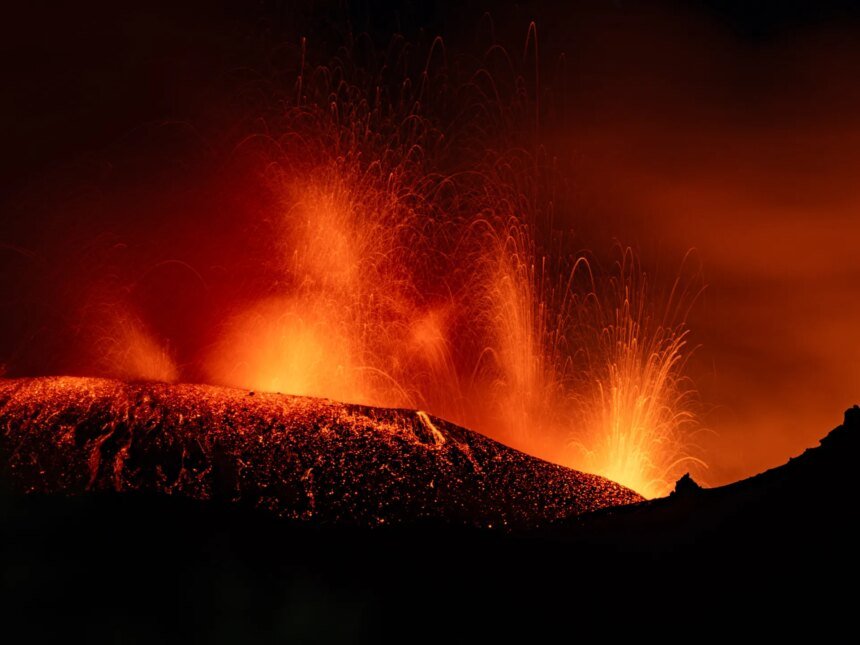
Satellite images obtained and analyzed by the Al Jazeera Network’s open source unit showed violent volcanic activity and heavy ash emissions from Mount Etna volcano on the eastern coast of the Italian island of Sicily.
This eruption, which began on July 5, caused widespread paralysis of air traffic and the temporary closure of Catania’s airport, before the intensity of the volcanic activity decreased and air navigation began to gradually recover.
Read also
list of 3 itemsend of list
Volcanic ash rising
A visual comparison of satellite images taken on July 2 and 5 reveals a huge column of dense volcanic ash rising from the main crater of the volcano.
The image taken on July 5 shows a change after the volcanic eruption, as a dense, dark gray cloud was emitted that extended longitudinally, heading south and southeast, covering large areas of the terrain surrounding Mount Etna.
The increasing intensity of emissions led to the formation of a volcanic cloud that reached a height of about 1.5 kilometers above the volcano’s summit. The Italian Volcano Monitoring Authority estimated the total height of the volcanic ash cloud at about 4,500 metres.
Air navigation affected
These satellite images intersect with field developments, as the ash cloud prompted the authorities to raise the aviation warning level from orange to red on July 6, suspend all incoming flights to Catania Airport, the busiest airport in Sicily, and cancel all departure flights until further notice.
Volcanic activity declines and flights resume
Following this wave of intense activity, the National Institute of Geophysics and Volcanology at the Etna Observatory announced in its statement issued on July 7, the cessation of volcanic activity in the Voragine crater, indicating the absence of any evidence of thermal anomalies or activity in the summit craters, with a decrease in the amplitude of the volcanic tremors.
Based on these data, the volcanic activity warning level for the aviation sector was lowered from red to orange, allowing Catania Airport to resume take-offs and landings and for the airspace sectors to return to operating at full capacity.
Mount Etna is the highest mountain on the Mediterranean islands, and the most active stratovolcano in the world, with a total height of about 3,320 metres. This explosive activity poses a direct threat to land and air traffic.