

Between documenting the pain of war and wrestling with stifling living conditions, the visual artist in Yemen today faces a fierce battle for survival, as the great rift and stark contrast between the reality of art before the conflict and what the current situation has become is clearly evident.
In light of this whirlpool, the Yemeni creator is making strenuous efforts to continue amidst enormous obstacles, presented by the harsh living conditions that have become besieging everyone. This is the same suffering that forces many artists to abandon their intellectual and spiritual production and sell it for small sums that do not support a living. Ultimately, creativity turns from a space for visual beauty into a silent cry of pain and a bitter attempt to survive.
Read also
list of 4 itemsend of list
A soft feather in a bullet-riddled neighborhood
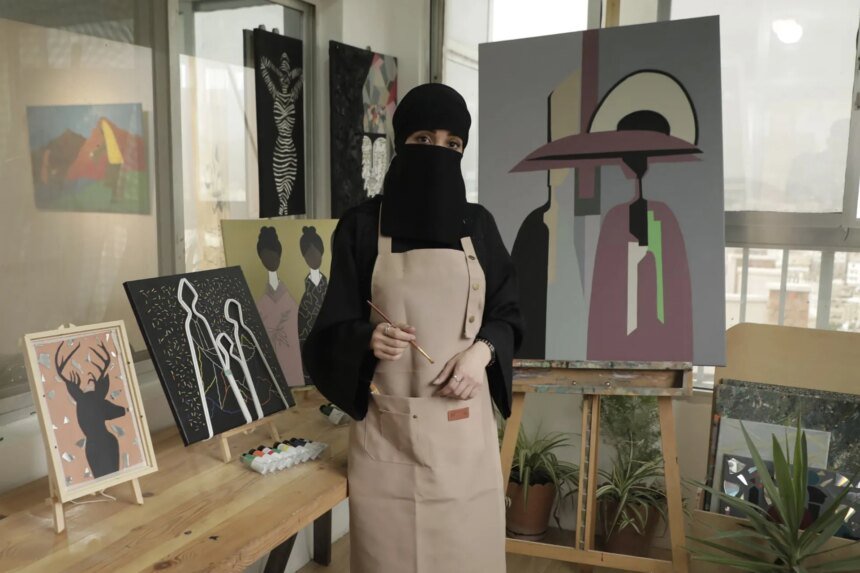
In a small corner of the “Al-Akhwa Neighborhood” overlooking the eastern regions of the city of Taiz, the young woman (Naamah Al-Shaibani) sits, drawing her paintings with her humble brush and beautiful colors, taking this neighborhood as a witness to the scourges of war, where bullets fill the walls of buildings, as a haven for expression. There, we met her to narrate the details of her artistic journey that extends since childhood, specifically since elementary school, where she refers to her beginnings, telling Al Jazeera Net: “I started drawing when I was in the fourth grade,” stressing in a tone full of passion that: “Art is what expresses our unspeakable feelings,” and these are the same feelings that she has used since her childhood to embody the suffering of her country, which is rife with conflicts.

Her craft takes on another dimension when it is combined with making a living. After she studied the specialty of (therapeutic nutrition) and faced the reality of the lack of job opportunities in her field, she reviewed her attempts, saying: “I studied therapeutic nutrition, and there is no job in this field. I tried to work in more than one thing, and I saw that there was no benefit. The last thing I reached was to draw and see a source of income, which could be in painting or something like that.”
She eventually came to the conviction that art might be her final gateway, noting that passion reformulates her goals: “My passion is also to reach a great stage in paintings, and to reach a greater place on the local or international level.” She added: “When I started selling my paintings, even if for small amounts, this gave me an incentive to get back to painting after I had been at the drawing board for a while.”
Art that does not fill the thirst
However, this motivation quickly collides with the bitter truth, which Naameeh describes in despair when we asked her whether art can be considered a source of income. She replied: “It is not a good source of income at all, even if this source is not worth the value of the tools that I bought for the painting.” She continues: “For me now, I sell my paintings. When I calculate the costs, I can get three or four thousand Yemeni riyals (about two or three dollars), meaning in exchange for effort. This thing makes no difference to me as much as I see my painting present when I see it.” People, as far as I can see, people are starting to demand art.”
Naima Al-Shaibani believes that relying on art as a real source of livelihood is almost impossible. She tells Al Jazeera Net: “As for a source of income, it is impossible in Taiz in particular, possible in Sanaa, possible in Aden. But he does not get any real income, because there is not sufficient awareness of art.” She attributes this discrepancy to the lack of societal awareness and purchasing power, as she points out that: “Even if the artist sells his painting, it will be for a very small amount, and even if it is a large painting, he may be forced to sell it. But he will not find the amount that he needs.” He wants it, and he has no right to bother him, but he is forced.”
Creating beauty from environmental fragments
In the midst of these material challenges, art schools in Yemen are diverse and complex, as Naima explains this diversity, saying: “There are many arts in plastic arts, such as traditional art, collage art, and the realistic school. Plastic arts are diverse and complex.” While the realist school remains the most widespread and closest to the conscience of society due to its direct contact with reality, Naima found her own identity and distinction in combining traditional art and collage art.

This passion, which began as a hobby and developed over time, is described by Naameh – during her talk to Al Jazeera Net – and how it affected her surroundings: “For me, I started art as a hobby, and then with time I began to develop myself. I noticed that people felt something different in my paintings. They used to say that there was feeling and feelings in them, and this encouraged me to continue and draw more. I found myself in traditional art, because it gives me freedom of expression without restrictions. I do not adhere to strict rules as much as I convey the feelings inside me.”
Paintings full of pain
However, she summarizes the general bleak scene of art in Yemen today with great bitterness, stressing: “As for the current state of art in Yemen, we as artists are suffering a lot. There is not sufficient media support, and no real opportunities for exhibition. Before the war, there were exhibitions and forums, and the paintings focused on the Yemeni identity and beautiful decorations. But now, the paintings have become full of pain, and reflect screaming and escaping reality, and this is the condition of the Yemeni artist today.”
Naima Al-Shaibani concludes her speech to Al-Jazeera Net by saying: “The problem is in marketing and selling. There are great difficulties, whether in society’s view of art or in the ability to buy paintings. Many people can barely provide for their basic needs, so buying a painting becomes difficult, especially in Taiz. This sometimes pushes the artist to sell his paintings despite his attachment to them, because he has no other source of income, and because the paintings remain piled up in the house without display or appreciation, which is also painful.”
Selling memories on social media platforms
On another level, the tragedy of the Yemeni artist is crystallized in a more profound way with the testimony of the visual artist Aziz Al-Maafiri, who was forced under the pressure of the need to display his paintings for sale on social media platforms, a behavior he describes bitterly, saying to Al-Jazeera Net: “As for displaying the painting on my Facebook page, which was in a forced manner, for me it is considered a harsh and sad situation. But the necessity was forced due to necessity, so I was forced to display it in a way that neither my psychology nor my feelings accept.”
Al-Maafiri adds to Al-Jazeera Net: “But sometimes you are forced to sacrifice part of your feelings for the sake of the message that you want to deliver in your name personally and in the name of artists in general, because many artists suffer from the same suffering, and their suffering may be greater than that.”

This pain extends to being intertwined with the spiritual value of the artwork, as he says: “This is what made me have to display the painting in this way, to deliver a message in the name of art and in the name of artists in Yemen. In terms of the painting, I displayed it in an urgent manner despite my pride in it, and when I said it was (a piece of my heart) I did not mean to provoke public opinion, but rather it was real pain and a harsh circumstance.”
He goes on to point out that selling the painting leaves a deep wound in the feelings: “Selling the painting when it is dear to you is unsatisfactory, because the painting is not just a frame, canvas, or colors. For me, it is a memory, nostalgia, and heritage. It contains the simplicity of the countryside and memories of living in it, and therefore the moment of selling it has a great impact on me,” stressing to Al Jazeera Net: “If my financial situation was stable, I would not have had to sell it at all.”
This suffering culminates in an artistic vision presented by Al-Maafiri about the sanctity of the original work, as he believes that: “The original painting is completely different from any copy, even if it is a picture from the phone, the original remains different emotionally; you feel its details and the spirit that is in it.”
He ends by saying that the relationship between the artist and his work does not end with the sale: “The artwork remains a kind of covenant and loyalty. It knows how much time it took from you, and what is the relationship between you and it, and even though it is sold or transferred to others, it still carries its impact and beauty.”
When the salary stops, the art continues
During Al Jazeera Net’s visit to the home of the artist and sculptor Walid Dallah, in Bab Al-Madajir in the old city of Taiz, the space seemed like a world saturated with art. A house overflowing with paintings and sculptures that carry the spirit of history and the pain of the present.
There, Al Jazeera documented his works related to war and history, especially those that embody the Palestinian cause. He won the Ministry of Culture award for a painting that embodied the events of October 7.
Despite this production, Dallah faces serious difficulties, the most important of which is the interruption of his salary for years. He tells Al Jazeera: “We artists in Yemen face great challenges. My salary has been cut for years, and it stopped when Muammar Al-Eryani was Minister of Culture, and to this day I am still demanding my rights to no avail.” Dallah adds to Al Jazeera Net: “The visual artists in Yemen have been suffering for a long time, and they have never lived in prosperity, and their lives have always been harsh and full of challenges.”

He believes that the crisis does not stop at the lack of support, but rather extends to the weakness of artistic taste in society, telling Al Jazeera Net: “There is a scarcity of artistic connoisseurs in Yemen; the circle of interested people is limited. We used to rely on selling our works to tourists and visitors, but Yemenis rarely buy paintings.”
Available statistics reveal an intermittent but continuous presence of plastic art in Yemen since 2015, as Sana’a witnessed a series of documented exhibitions, most notably the (Art in the Face of Aggression) exhibition on October 13 and November 24, 2015, then the (Plastic Art in the Face of Aggression) exhibition on January 20, 2020, and the (Small Colors) exhibition in February of the same year, while Aden hosted the January 15, 2020 The tenth exhibition of the Vision Dialogue group, as one of the most prominent independent artistic groups.
In Taiz, which is living in a different context due to the war, the exhibition (Break the Siege on Taiz) emerged, which opened on October 27, 2020 and continued for days, bearing a clear protest nature.
In contrast, activity in the rest of the governorates remained less documented in the media, despite the presence of separate activities between 2017 and 2023, which reflects a gap between artistic production and cultural coverage, and confirms that the fine arts scene in Yemen is in a state of survival rather than a state of prosperity.