


Published On 7/7/2026
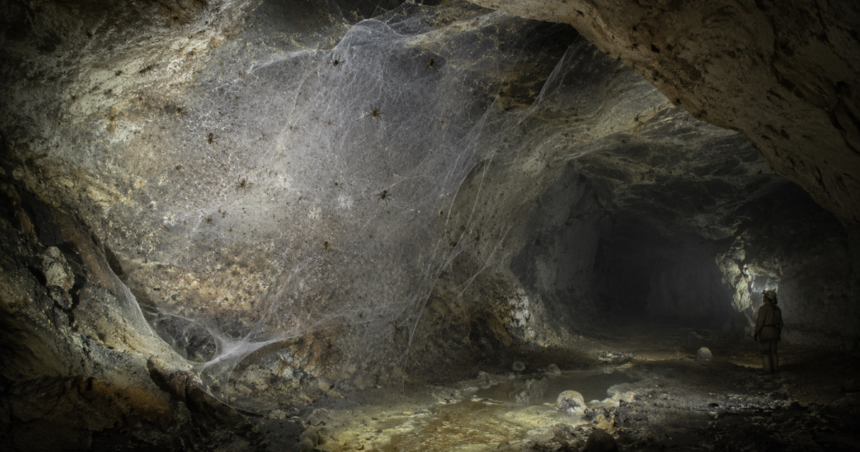
Deep in a dark cave stretching below the border between Greece and Albania, an international team of scientists has discovered one of the strangest natural phenomena recorded to date: a giant spider web measuring 106 square metres, the equivalent of about half a tennis court, making it likely the largest known collective spider web in the world.
The discovery came inside the Sulfur Cave, located in northern Greece, some of whose corridors extend to southern Albania, and is part of a huge limestone labyrinth that includes wide halls and winding tunnels formed by the Sarandaboros River over thousands of years.
A study published in the journal Subterranean Biology revealed that this web, large enough to catch a whale, was not woven by a single spider, but was built by a colony of about 111,000 spiders of two different species, in behavior that has never been scientifically documented.
Using genetic analysis, the researchers estimated that the web included about 69,000 funnel-weaver house spiders, in addition to more than 42,000 Brennerigoni vagans.
The researchers explained that this represents the first documented evidence of these two species cooperating in building a joint colonial network, although they do not usually interact in this way in surface environments.

Unique ecosystem
The Sulfur Cave is characterized by a unique environment, as it is penetrated by sulfur-rich water that emits a smell similar to rotten eggs, while light is completely absent from its depths.
Unlike most ecosystems that rely on plants and sunlight, this cave relies on chemotrophs, where microorganisms derive energy from chemical reactions of sulfur compounds rather than photosynthesis.
Sulfur-loving bacteria cover the walls of the cave with a sticky layer, which is the primary food source for insect larvae and small flies, which in turn have become the favorite food for tens of thousands of spiders. The researchers noted that the bulk of the giant web was concentrated in an area that witnessed an exceptional density of chironomid flies, which explains the enormous size of the web.

Not the largest web of a single spider
Although this web is the largest of its kind among group webs, some individual spiders can also build amazing webs. Among the most prominent is the Darwin’s bark spider, which lives in the forests of Madagascar, as it can weave webs extending up to 25 meters over bodies of water, despite the fact that its body size does not exceed the size of a coin.
The researchers believe that this discovery provides new evidence of the ability of harsh and isolated environments to push organisms to develop unexpected cooperative behaviors that were not known before.