

Russian newspapers discussed the height of the internal and external crises that the United States was experiencing, and saw that they were reflected in the decline of the “American dream” for ordinary citizens, and that the loss that Washington suffered in the war with Iran deepened it, indicating that the American-European tensions constitute an opportunity for the Kremlin.
Collapse of the “American Dream”
Vitaly Ryumshin wrote in the newspaper “Gazeta” that the United States celebrated the 250th anniversary of its declaration of independence, but Americans are not in the mood to celebrate in light of the current circumstances in the country.
Read also
list of 2 itemsend of list
The writer highlighted the results of an opinion poll conducted by Reuters, and said that they are not promising at all, as they showed that 70% of Americans no longer consider their country to be the greatest country on earth, and that 64% are convinced that American democracy is in danger, while 38% believe that the United States will not last another 250 years as a unified country.
The writer saw that “ideological concepts” in the United States began to decline significantly in the twenty-first century, and the first questions began to appear even among the American millennial generation born between 1981 and 1996.

According to the author, the parents of this generation were getting rich quickly, buying real estate and traveling abroad, but for some reason, the children were drowning in debt and did not see any hope for the future, because previous generations were statistically ten times richer than them.
For the younger generation in the United States – as the author points out – the “American Dream” has become just a joke, just as the “bright communist future” was for Soviet citizens.
The collapse of the future vision led to a state of widespread confusion and loss, and it became clear to everyone that the system was no longer working efficiently, and thus two contradictory answers to these questions crystallized in American society, according to the writer’s opinion.
On the one hand, right-wing conservatives believe that America will be saved by a pragmatic renaissance, represented by a fully free market, a focus on big entrepreneurs, maximum efficiency in government spending, and a rejection of the rigid ideological principles that underpinned the country’s international policy.
As for the progressive left-wing Americans, they are convinced of the necessity of preserving the pillars of liberal democracy regardless of the circumstances, and they see the solution in radical economic restructuring with a fair distribution of national wealth.
It was expected – according to the writer – that an era of major social experiments would begin with the presidency of Donald Trump, who promised a quasi-right-wing revolution, and had already begun to implement his ideas, but it soon became clear that there was no coherent plan behind his actions.

However, the writer believes that Trump does not pay attention to lofty matters, and only thinks about himself, noting that if he had all the affairs in his hand, he would fill Washington with luxurious halls and triumphal arches.
In this sense, Trump’s approach to celebrating the 250th anniversary of America’s founding was no less disappointing to his supporters than the war with Iran, as people expected the American president to set some political program, or at least to symbolically conclude the path the country had taken.
But Trump, instead, continues to talk about his achievements, while many wonder whether the country is already celebrating the 250th anniversary of its founding, or whether it has not yet finished celebrating the 80th birthday of its president.
The writer continued: America is now moving towards the left due to its great disappointment with the right-wing trend, represented by the socialist – as he put it – Zahran Mamdani, who was elected mayor of New York City.
A lost victory
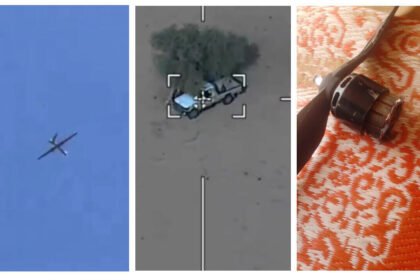
On the New East website, Viktor Mikhin wrote that the 39-day war on Iran represented the first serious signal to the United States that industrial-age military power was collapsing in the age of cheap drones and artificial intelligence.

The writer continued that the goals of the American war on Iran were not achieved, as the regime in Tehran did not fall. Rather, the assassinated Supreme Leader was quickly replaced by his son, and Iran’s military capabilities were not destroyed, as about 70% of its missile arsenal and launch platforms are still ready to operate, according to American intelligence.
As for the stocks of enriched uranium, they were buried in tunnel complexes and remained under the control of Tehran, which maintained its control over the Strait of Hormuz.
The lessons of the “defeat” in Iran – according to the author – shape the Pentagon’s future plans. At first glance, it appeared to be a war with an uncertain outcome, but the historical perspective that opened 100 days after the start of the conflict testifies to the strategic defeat that the United States suffered.
The writer refers with a kind of sarcasm to Trump signing a memorandum of understanding with Iran in Versailles in June 2026, as it was difficult to ignore the symbolism of this site, where Germany signed the Treaty of Versailles in 1919. This agreement, which was concluded from a position of weakness – according to the writer – represented the United States’ surrender to the goals it announced at the beginning of the war.
The writer adds that the failure of the United States is not due to a lack of tactical success as much as it is due to a radical shift in the nature of the war itself, as it turns out that the technological superiority that the Pentagon relied on for decades was an illusion in the face of a new military reality.
According to what the writer concluded, replenishing the stocks that Washington lost in the war against Iran will take many years, which makes American forces vulnerable, not only in the Middle East, but also in Asia and Europe.
Whenever two opponents quarrel, the third wins, and therefore the destruction of Euro-Atlantic unity must become the Kremlin’s basic and long-term strategy.
“Useful divorce”
Writer Vladimir Golovlashin considered that the “separation” of the European Union and the United States constitutes an opportunity for Russia, and in an article on the “Tsargrad” website, he saw that the American President’s repeated attacks on his European allies are not due to trade disputes at all, but rather a fundamental geopolitical rift.
The writer saw that the matter did not stop at Trump’s threats to withdraw from the North Atlantic Treaty Organization (NATO) because no one supported the White House in its adventure with Iran, but rather that the rhetoric has now reached a qualitatively new level.
Trump’s description of Europe as “Third World” is no longer just talk, but has become a diagnosis given to a patient whose doctor is preparing to discharge him from the hospital to die at home, out of concern not to distort the statistics, according to the writer’s description.
The writer confirms that relations between the United States and the European Union have reached their lowest levels historically, and that the transatlantic unity that seemed solid for decades has begun to crumble. He points out that for Moscow, this radical transformation is not just a source of gloating, but is also an opportunity not to be missed.
Golovlashin points out that the trade war has become a weapon in this conflict, and that the new tariffs imposed by Trump have severely harmed European cars, steel, luxury goods, and chemicals, and thus Europe is losing its markets.

While European bureaucrats in Brussels pretend that everything is going according to plan, Trump is systematically destroying the transatlantic “partnership,” because Washington views Europe not as an ally, but as a competitor that must be weakened.
Therefore, according to the author, America is now trying to repeat the same trick that it practiced on the countries of the European socialist bloc at the end of the Cold War, which is to destroy industry and occupy the markets that were vacated.
The writer wonders what this means for Russia? Pointing out that tearing apart the West by internal conflicts gives Russia room to maneuver, because division within NATO, trade wars, and loss of confidence among allies weaken the West in general, forcing Europe to spend its resources on its defense, and plunging the United States into Middle East conflicts.
The writer states that whenever two opponents quarrel, the third wins, and therefore the destruction of Euro-Atlantic unity must become the Kremlin’s basic and long-term strategy, especially since the division between the United States and the European Union is not just passing news, but rather the decisive end to the Cold War and the era of the unipolar world.
The author concludes that Russia stands on the cusp of a decisive geopolitical round, and to achieve this, it must move quickly, decisively and realistically and not stand idly by and watch the West struggle with each other.