
Published On 7/6/2026
|
Last update: 7/7/2026 01:36 (Mecca time)
Afghanistan held the funeral of the first Afghan astronaut, Abdul Ahad Momand, in the capital, Kabul, on Monday, after his body was returned from Germany, where he died last week at the age of 67 after a long struggle with illness.
The funeral prayer was held at the Eidgah Mosque in the Afghan capital before Momand’s body was buried in the Marangan Hill Cemetery.
The ceremony was attended by Taliban officials, members of his family, and hundreds of mourners who gathered to pay their last respects.
According to the Taliban Foreign Ministry, Momand’s body was returned from Stuttgart, Germany, for burial in his homeland at the request of his family, who reported that he was suffering from cancer.
His passing sparked a wave of condolences from Afghans at home and abroad, with many remembering him as a symbol of national achievement and one of the country’s most prominent public figures. His burial in Kabul marked the end of a busy career that established a unique position for him in the history of Afghanistan as the first Afghan astronaut.

Holy Quran and Pashto
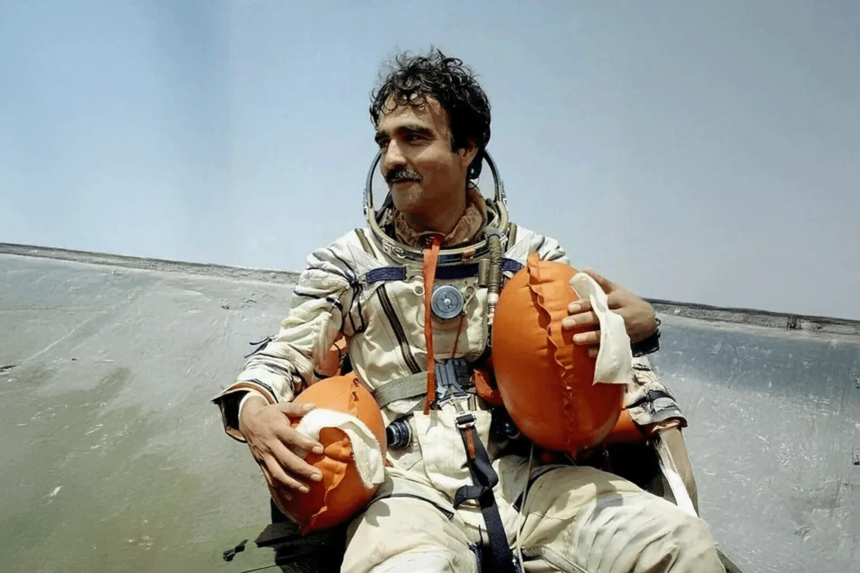
Momand made history in 1988 when he became the first Afghan to travel into space, when he traveled aboard the Soviet Soyuz TM6 spacecraft on a mission to the Mir space station. He spent about 9 days in orbit and conducted scientific experiments with a Soviet and Syrian crew.
Momand was 29 years old during that historic flight, and he was keen to carry with him a copy of the Holy Qur’an and recite it inside the space station. From there he also made a phone call to his mother, making Pashto the fourth language spoken in space.
The flight was launched on August 29, 1988, to the Mir space station, and returned to Earth on September 7 of the same year. The mission was supposed to last 8 days, but it extended to nine days due to technical malfunctions, which were dealt with successfully before returning to Earth.

biography
Abdul Ahad Momand was born in 1959 in the village of Sardi in the Afghan province of Ghazni. He received his primary education in his village, then at the Sultan Shihab al-Din School in Ghazni, before moving to Habibia High School in Kabul.
He then joined the Polytechnic Institute in Kabul to study for two years, before traveling to the former Soviet Union, where he received three years of aviation training.
After returning to the country, he served at Bagram Air Base between 1981 and 1984 as an Air Force pilot, and then between 1984 and 1987 he joined the Kiev Aviation and Engineering University to pursue his graduate studies.
During that period, he participated with a group of pilots in qualification tests for space flights, and this process lasted only six months, while for astronauts from other countries it took between 18 months and two years.
Shortly after his return from his space trip, he headed to Moscow to study the pillars of war, and later worked between 1988 and 1991 at the Academy of Sciences in Afghanistan. He also served for a period as Deputy Minister in the Afghan Ministry of Aviation and Tourism for Technical Affairs.
At the beginning of 1992, with the outbreak of the civil war in Afghanistan, he left the country, immigrating to Germany with his family, and resided in the city of Stuttgart, where he worked at the Institute for Cosmic Research of the University of Stuttgart, in addition to a private company in the city, where he lived with his wife and three children (two daughters and a son).
Despite living abroad, he remains widely appreciated in Afghanistan for his pioneering role in space exploration and his contribution to the country’s scientific legacy.