

Published On 5/7/2026
|
Last update: 10:37 (Mecca time)
Before the anticipated confrontation between Brazil and Norway in the quarter-finals of the 2026 World Cup, a historical fact returns to the fore that puts the Scandinavian team in a unique position among all of the Seleção’s competitors. Despite the rich history of the Brazilian national team, Norway remains the only national team that has not lost to them in any confrontation.
The two teams have faced off four times throughout history, two of which ended with Norway winning, while the other two matches were decided in a draw, in an exceptional record that no other team has succeeded in achieving against Brazil.
Read also
list of 2 itemsend of list
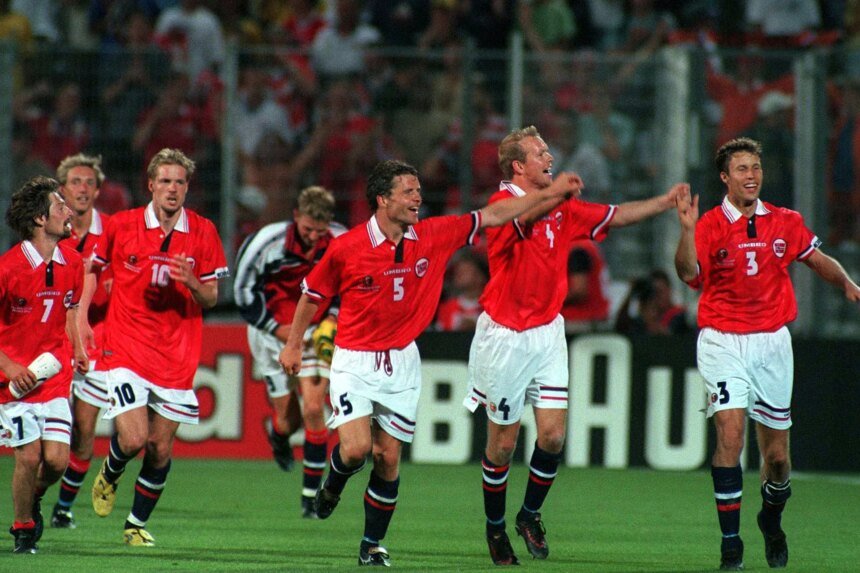
However, the most memorable confrontation remains the one that brought them together on June 23, 1998 at the Velodrome Stadium in Marseille, when the Norwegian team came from behind to win a historic score (2-1), reaching the final of the World Cup and writing one of the brightest pages in its sporting history.

A night that Norwegians will never forget
If it is difficult for many to recall the details of the evening of June 23, 1998, the situation is completely different in Norway, where that match turned into a turning point in collective memory.
Geir Jordt, professor of sports psychology at the Norwegian School of Sports Science, recalls the atmosphere of that night: “I was in downtown Oslo. It was crazy. The streets were full of people singing and dancing, and no one wanted to go home. It was a moment that did not resemble the calm Norwegian character.”
Many Norwegians believe that this victory was not just a qualification to the next round, but rather a national moment that rarely went beyond football.
The story begins before the World Cup
The victory over Brazil in France 1998 was not a coincidence, as it was preceded by another victory a year that gave the Norwegians great confidence.
On May 30, 1997, the Norwegian national team defeated Brazil, the World Cup holder at the time, with a score of (4-2) in a friendly match held at the “Ullevaal” Stadium in Oslo, thanks to a brace by striker Tore Andre Flo.
That victory strengthened coach Egil “Drilo” Olsen’s belief that his team was capable of defeating Brazil again, but on different conditions.
Olsen said in statements he made in 2016: “We knew that we were capable of beating them, but that was not possible if we played the way they played. Our players were less than them in skill and individual abilities, and if we had tried to match their style, we would have lost the match before it had even begun.”
A tactical plan that turned the tide
Olsen relied on a style based on defensive discipline, reducing spaces, and direct play, while exploiting long balls and counterattacks, with the aim of reducing the danger of a Brazilian team that included names such as Ronaldo, Bebeto, Dunga, and Roberto Carlos.
Although Bebeto gave Brazil the lead in the 78th minute, the Norwegian coach did not change his plan, but rather continued to bet on his style until the end.
Olsen reveals that Dunga went to him after the goal and told him to be silent, due to previous statements in which he criticized Brazil’s ineffective reliance on possession, during which he described the organization of the midfield as “resembling a garbage dump.” The coach later explained that these statements were not motivated by provocation, but rather an expression of his artistic vision.”
“Flo’s Plan” resolves the confrontation
The most prominent weapon in Olsen’s plan was giant striker Justin Flo, who pushed him during the second half to exploit his physical superiority in the air.
The Norwegian coach said: “Justin was not the most skilled player, but he is the best vertical player I have ever seen in my life. We deliberately targeted him almost constantly, because he was facing Roberto Carlos, and he won almost all the air balls.”
Just three minutes after his entry, Jostin set up the ball for his brother Toure Andre Flo, who scored the equaliser, before five minutes later he caused a penalty kick from which Ketil Reykdal scored the historic winning goal.

A victory that angered Brazil
The defeat did not go unnoticed within the Brazilian camp. Olsen narrates that Roberto Carlos went to Justin Flo after the match, and said to him sarcastically: “You should have played basketball. I don’t understand how a technically limited player can be a winger.”
But the Norwegian coach refused to underestimate the value of the achievement, stressing that his team was the better party.
He said: “We created more chances than them, and our percentage of offensive passes was higher. Football is not only possession, but effectiveness, and we were the most effective.”
More than a sporting victory
The impact of that victory did not stop at the borders of the green rectangle, but rather it turned into an exceptional event in the collective consciousness of Norwegians. Geir Jordt believes that the scale of celebrations witnessed by the country after the match is only comparable to the atmosphere that accompanied the liberation of Norway in 1945.
As for former international goalkeeper Erik Thorstedt, the father of current midfielder Christian Thorstedt, he believes that choosing a group stage match as the greatest sporting moment in the country’s history reflects the symbolic value acquired by that victory.
“We are a nation that has achieved great achievements in winter sports, but beating Brazil in the World Cup remains the moment everyone talks about,” he says.

A new test before history
28 years after that historic night, the two teams find themselves face to face again, but in different circumstances and with greater ambitions.
Brazil is seeking to end a historical knot that has eluded it against Norway, while the “Vikings” enter the confrontation supported by a unique record that makes it the only team to maintain its record undefeated against the “Seleção.”

Between a history that is still fresh in memory, and a reality that imposes new challenges, the quarter-final confrontation appears to be more than just a match for the qualification ticket, as it represents a test of Brazil’s ability to break a complex that has lasted for decades, and an opportunity for Norway to add a new chapter to one of the most strange stories in the history of the World Cup.