


Al Jazeera correspondents

Published On 5/7/2026
|
Last update: 13:36 (Mecca time)
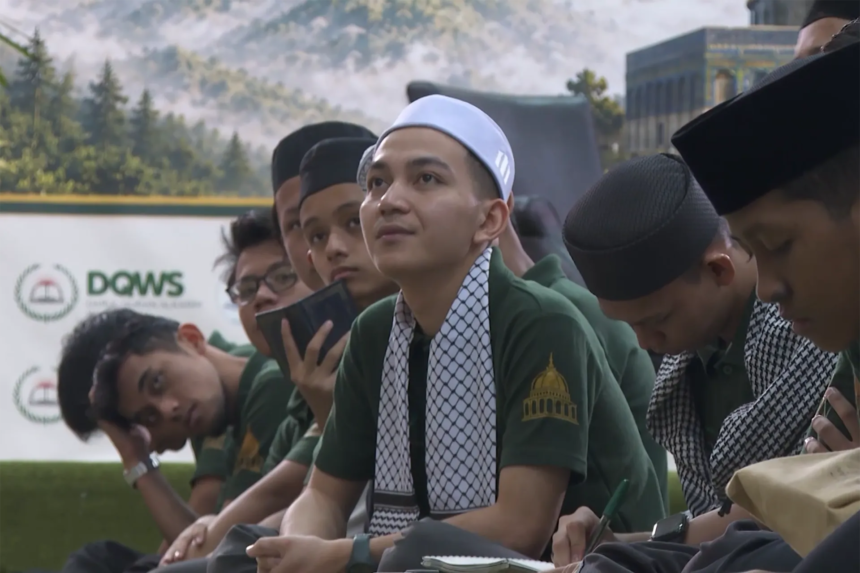
Jakarta- Palestinian youth from Gaza transferred a unique Qur’anic experience to one of the countrysides of Bogor Governorate in West Java, Indonesia, by organizing the “Taj Al-Waqar 2” camp, which is based on memorizers and memorizers narrating what they have memorized from the Book of God Almighty in an atmosphere that links them to Palestine and Al-Aqsa Mosque.
Male and female students from different regions in Indonesia participate in the camp, which lasts a full week, during which they demonstrate the memorization they have accumulated over months and years, within an intensive daily program that simulates an experience that originated in Gaza about 20 years ago, and later moved to Türkiye and then to Indonesia.
Read also
list of 4 itemsend of list
From wounded Gaza to the Bogor countryside
Bilal Al-Ramli, supervisor of the “Taj Al-Waqar 2” camp in Indonesia, says that what distinguishes this event is that it is an extension of a pioneering Qur’anic experience that originated in Gaza, despite the wounds and challenges.
He added in his interview with Al Jazeera Net that Gaza, “despite the pain and wounds it is suffering, was able, thanks to God Almighty, to export this project to the nation,” explaining that transferring the experience to Indonesia is “an important message that the Qur’an brings the nation together, and that the goodness that is born in one place, no matter how small, can be transmitted to other places.”
Al-Ramli continues that the camp brings together male and female students from different regions in Indonesia “to be educated at the tables of the Qur’an and carry the values of sincerity, discipline, leadership, responsibility and morals, so that they return to their communities carrying the light of the Qur’an in morals, knowledge and message.”

A brotherhood that transcends borders
In the camp courtyard, Arabic and Indonesian mix in review and memorization sessions. Fani Afnan Janati, a participant in the Qur’anic Narrative Week, says that the presence of participants from different Indonesian cities and from Palestine created a space for getting to know each other and building broader bonds.
She explains that the camp “enhances social interaction because there are participants from different cities, including participants from Palestine. We can talk to each other, strengthen the bonds of connection, and enhance Islamic brotherhood so that we get to know each other better,” adding that the goal is “to strive together to build the spirit of the Qur’an in our hearts, because we will preserve the Qur’an, memorize it, and review it until death.”

The “true keeper” lifestyle
Commitment to the Hafiz lifestyle is one of the camp’s pillars. Participant Muhammad Sufyan Hadi explains that the camp days begin at three in the morning with waking up for Tahajjud prayer, then a morning session that extends until nine.
After that, the participants have a nap, and then after the noon prayer, scientific sessions are held with the participation of local speakers and others from different countries, before the narration and review sessions continue in the following periods of the day.
Hadi points out that the camp is not limited to those who have completely memorized the Qur’an, but also includes those whose memorization is still small. “There are those who increase their memorization, those who strengthen their memorization, and those who want to get closer to the Qur’an more,” in one experience that brings together different levels around one center, which is connection to the Qur’an.
Palestine is present in the details
Although the camp is held in the Indonesian countryside, Palestine is present in its daily details. From the names of the episodes to the stories that supervisors coming from Gaza tell about their journey with conservation under bombardment and siege.
Those in charge of the camp confirm that the goal goes beyond establishing memorization to build a generation that holds the Qur’an and the Palestinian issue together, and feels that its connection to the Holy Book can be a true bridge to the unity of the nation, no matter how far apart the geography is.