

Published On 5/7/2026
|
Last update: 12:56 (Mecca time)
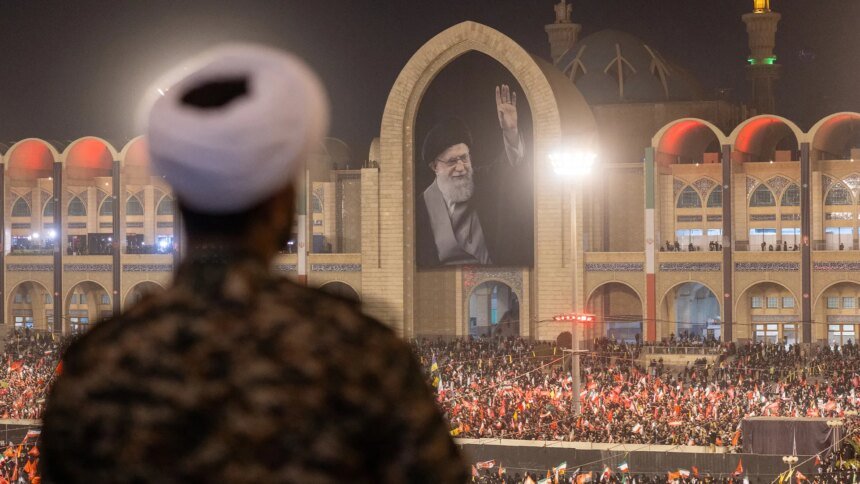
All eyes are on the Iranian capital, Tehran, which is preparing to receive a massive funeral ceremony for the late Iranian leader Ali Khamenei and his family, in a scene in which the widespread popular presence is mixed with political and military messages, amid official alert and regional and international anticipation of what the next stage will lead to, coinciding with a temporary stagnation over the course of international negotiations.
Al Jazeera’s correspondent in Tehran, Omar Hawash, said that expectations indicate the possibility of between 20 and 30 million people participating in the funeral ceremony, explaining that the Iranian authorities are keen to ensure broad popular participation because of the messages the occasion carries at the internal and external levels.
The correspondent explained that Tehran seeks, internally, to emphasize the unity of the Iranians in the face of Israel and the United States, and to highlight the continued popular support for the official position, not only at the military level as it was during the previous stage, but also for the political track that entered into negotiations with the United States during the last period, with expectations for the resumption of final solution negotiations after the end of the funeral ceremony.
He added that the ceremony also carries regional and international messages, as Iran wants to confirm that it has emerged strong from the war with the United States and Israel, and that it is still capable of waging a new confrontation if necessary, in addition to its ability to organize a ceremony of this size with popular participation and official and international presence.
In the same context, Al Jazeera’s correspondent reported that invitations to participate in the funeral ceremony were issued on a large scale by the heads of the three authorities, namely the Iranian President, the Speaker of Parliament, and the Head of the Judiciary, in addition to similar calls launched by the military establishment urging citizens to participate in the activities that extend throughout the week.
In this context, Hawash referred to what was stated in the statement of Iranian President Masoud Pezeshkian, who called on citizens to participate in the funeral ceremony, and said: “Iran will begin to open a new chapter in the future, and the funeral of the late Iranian leader is not just a funeral procession, but rather the beginning of a new phase based on the fact that the leader has become a symbol of resistance and steadfastness in the face of enemies.”
Symbolism controversy
For his part, the former Iranian diplomat, Hadi Afaghi, confirmed that the funeral scene proved that the Iranian people are “unified and harmonious around their leadership,” declaring that the people stand behind the new leader Mojtaba Khamenei, who was elected by the Leadership Council of Experts in accordance with the provisions of the Constitution, and declaring allegiance and commitment to the approach drawn by the late leader.
In an interview with Al Jazeera, Afqahi warned those described as “enemies” of the need to reconsider their calculations “a thousand times” before undertaking any adventure against the Islamic Republic, citing the arrival of official delegations from more than 100 countries to participate in the ceremony.
He explained that the bodies would later be transported to the city of Qom, then to Iraq, to roam between Karbala, Najaf, and Kadhimiya. He also stressed that the current leadership and government headed by Masoud Pezeshkian are following the same approach, pointing out that the new guide allowed negotiations to continue between the Iranian and American parties.
On the other hand, the former head of the Republican Party Committee in Washington, Patrick Marra, downplayed the symbolic dimension of the ceremony, stressing that what matters to the United States at this stage is “Iran’s behavior, not symbolism.”
Mara explained that Washington is focusing on how Tehran behaves towards the Strait of Hormuz, the International Atomic Energy Agency’s inspections, and the extent of its willingness to stop supporting its agents in sovereign countries, especially in Lebanon.
Mara expressed “American optimism” and positive signals from President Trump to reach a final agreement on the memorandum of understanding as quickly as possible, driven by political pressures that were partially alleviated by the opening of the strait and its positive impact on fuel and gasoline prices, while technical channels remained open through intermediaries.
Negotiating from a “standpoint of strength”
In turn, Al Jazeera’s correspondent in Washington, Ihab Al-Absi, reported that US President Donald Trump, despite his preoccupation with the celebrations of the 250th anniversary of independence, followed the course of the funeral ceremonies in Iran, noting that this appeared in statements he made to the website “Axios”, in which he said that he watched the funeral ceremonies and expressed his astonishment at the scenes of Iranians crying for the late leader, considering sarcastically that those tears “may be fake tears.”
The reporter explained that Trump revealed, in his statements, an agreement with the Iranian side to grant a period of one week to allow the burial ceremony to be completed, a period that coincides with the United States’ independence anniversary celebrations.
Al-Absi added that Trump stressed that all current leaders in Iran “can be eliminated with one shot,” as he put it, but at the same time he made it clear that he would not do that because “there will be no one left to negotiate with,” in reference to his commitment to maintaining the negotiating track despite his escalatory tone.
Al Jazeera’s correspondent pointed out that the American President continues to talk about the Iranian file from the standpoint of military superiority, explaining that he said in a speech he gave hours ago on the occasion of Independence Day that the American army “completely eliminated the Iranian army,” and that 159 ships from the Iranian navy were destroyed. He also claimed that the Iranians are “begging” to reach an agreement to end the conflict.
Al-Absi pointed out that Trump did not provide additional details regarding the course of the negotiations, but he stressed that any anticipated negotiating round, which is expected to resume after the end of the funeral ceremony, will take place from a position of strength with respect to the United States, according to his description.
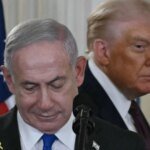
In a related context, Al Jazeera’s correspondent reported that Trump announced that Israeli Prime Minister Benjamin Netanyahu requested a meeting at the White House, and it is likely that this meeting will take place after the end of the NATO summit, either during the next week or the following, without setting a final date yet.
Al-Absi explained that this upcoming meeting comes at a time when the differences are still clear between Washington and Tel Aviv regarding the mechanisms for dealing with Iran, in addition to the differences related to developments in Lebanon and the settlement of the related regional files.