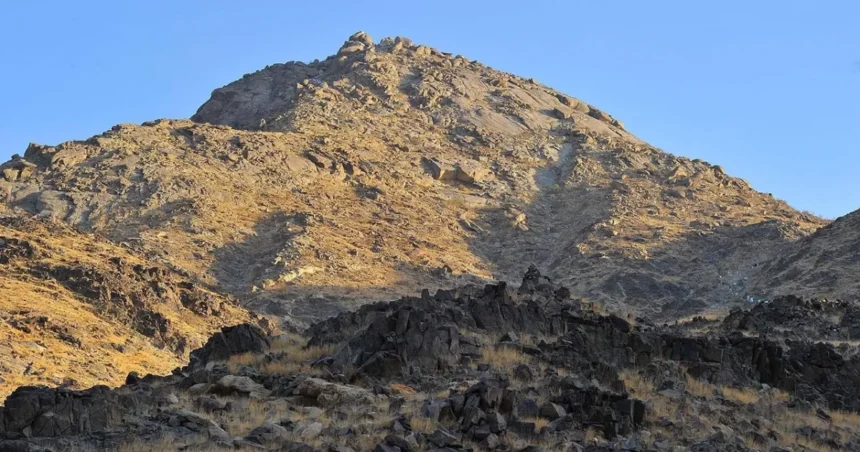
The migration path of the Messenger, may God bless him and grant him peace, from Mecca to Medina included dozens of mountains, but only one mountain included a cave in which the Messenger and his companion, Abu Bakr al-Siddiq, stayed for 3 days. It became an important Islamic symbol and a witness to the most prominent station in Islamic history, which is “Mount Thawr.”
But it seems that the history of this mountain is ancient, as an American geologist who spoke to Al Jazeera Net suggests that the rocks of this mountain were formed underground over a period of 800 million years, and then the magma cooled and solidified in the depths.
Dr. Thomas Winslow Sisson, a geologist at the Volcanology Center of the US Geological Survey, says that Mount Thawr consists of solid “granite” rocks, which are igneous rocks that did not form directly on the surface of the Earth, but rather began as “subterranean magma” at deep depths, then it rushed and intertwined between the earth’s layers, and after that it cooled and solidified very slowly under the surface, before tectonic movements lifted it and erosion factors exposed it over the ages to reveal the mountain.
He explains that historical studies of the rocks of the Mecca region indicate that the eruption and solidification of this magma did not occur suddenly, but rather through two main batches separated by a long time. The first batch (the oldest) dates back to between 824 and 802 million years ago, while the second batch (the geologically youngest) was formed about 664 million years ago.
Determining these numbers depends on what is known as “radiometric dating,” which is like a natural time clock inside the rocks, as granite contains very small amounts of natural radioactive elements (such as uranium) that decay at a constant rate that does not change over time to turn into stable elements (such as lead). By measuring the products of this decay, the age of the rock can be calculated with extreme accuracy.
He adds that “the uranium-lead technique”, which is performed on the mineral “zircon”, which is found in all granite rocks, is the most accurate and reliable in the world, because zircon crystals are very resistant, so that radioactive records are trapped inside them without being affected by external factors.
Despite what is scientifically available about the age of the rocks of the region as a whole, this does not prevent, according to Thomas, from subjecting the “Jabal Thawr” granite to this precise technique to determine its precise age.

Old rock…newer mountains
Thomas distinguishes between the age of the mountain rocks and the origin of the mountain itself, and points out that the granite rocks that form the structure of Mount Thawr and the Arabian Shield solidified in the ground more than 800 million years ago, but these rocks remained buried for a long time, and did not begin to rise to transform into terrain and towering mountains until recently, specifically in the Miocene era.
The famous American geologist links the emergence of the mountain to a great tectonic event, which is the birth of the Red Sea. He said, “25 million years ago, the Arabian Peninsula began to move away and separate from the African continent, an event that led to the birth of the Red Sea, and with it the western highlands of the Kingdom began to gradually rise, and 14 to 10 million years ago the region witnessed a violent and powerful wave of ascent, during which the mountains of Mecca and Hijaz jumped to the towering heights that we see today.”
Unlike world-famous mountains such as the Himalayas, which arose as a result of the collision of Earth’s plates with each other (compressive forces), the mountains of Mecca, including Mount Asir, arose in a completely opposite way, which Thomas explains.
He says, “During the separation of the Red Sea, the Earth lost a large portion of the deep, dense, very heavy rocks that lie directly beneath the crust (the lithosphere of the mantle). In addition, the Earth’s crust of the Hijaz region was exposed to enormous heat from the Earth’s interior, which led to the expansion of its rocks and a decrease in their density, so they became lighter. As a result of its lack of density, the Earth’s crust floated upward above the molten interior of the Earth due to the natural buoyancy factor, so that these majestic mountains rose.”
The American geologist likens this mechanism, which revealed Mount Thawr in the past, to what happens in the high elevations surrounding the “Afar Depression” in the Great African Rift region of Ethiopia, where the earth expands and diverges, and the internal heat causes the surrounding mountains to rise by the same mechanism.
How to form the cave of Thor?
Regarding how the cave of Thawr was formed in the heart of the mountain, Thomas takes us to an exciting geological story whose events he was able to read by looking at pictures of the mountain and the cave.
He says, “Photographic snapshots of the summit and slopes of the mountain show that the solid granite rocks did not retain their sharp angles due to climatic factors, as they were exposed over many centuries to a geological phenomenon known as “rock weathering,” where winds and temperature differences between day and night caused the edges of the rocks to crumble and erode very slowly, which over time led to their polishing and transformation into huge, massive circular blocks, known scientifically as “round boulders.”
It moves to the next chapter of the story, where these huge round granite blocks rolled from the top of the slopes due to gravity and natural displacement factors, until one of these huge rocks fell and settled precisely on top of a wide rock crack or crevice between two rocks, to act as a “natural roof.”
The conclusion of the story was that this natural stability of the rock left behind and beneath it an empty and protected space, which is the precise geometric formation that we see today in “Ghar Thawr.”

Three different pieces of information
According to the above, it seems that Mount Thawr in Mecca is not just a prominent landmark in Islamic history, as Thomas sees it as a “geological archive.”
He says, “The granite rocks that make up this majestic mountain carry within them three different pieces of information, waiting for modern laboratory techniques to read them to reveal the secrets of the Earth’s ancient environments.”
The first of this information is “knowing the exact moment at which the hot subterranean magma cooled in the interior of the earth to turn into solid rock, which is an essential step for determining the exact time of the formation of the mountain’s rocks. This information can be obtained through the use of a precise technique known as (uranium-lead) applied to the microscopic crystals of the mineral “zircon” available in granite.”
The second piece of information is “when did the rocks jump to the surface?” The rocks in the depths of the Earth are extremely hot, but when tectonic movements and erosion factors begin to push these rocks upward, they begin to gradually cool as they approach the surface. Techniques can be applied to determine the “age of the rise,” most notably “dating the fission paths in apatite,” a natural mineral in granite in which radioactive particles leave microscopic paths affected by heat. A dating technique can also be used. (Uranium – Thorium – Helium) in zircon.
As for the third piece of information, it is the time that the mountain spent exposed. Once the mountain stabilizes in its final form and its rocks become completely exposed to the air, a new phase of natural documentation begins through “cosmic rays,” which are high-energy particles coming from outer space that constantly bombard the Earth’s crust. These rays penetrate the first few centimeters of the rock, and cause some of the elements inside to transform into “unique radioactive isotopes.” By measuring these isotopes in the laboratory, it is possible to calculate the exact amount of time that the mountain spent time exposed. The rock faces the atmosphere.
By obtaining these three pieces of information, Mount Thawr is transformed from a mere religious and historical landmark in the conscience of the Islamic world into a geological document that summarizes amazing chapters of the history of planet Earth.