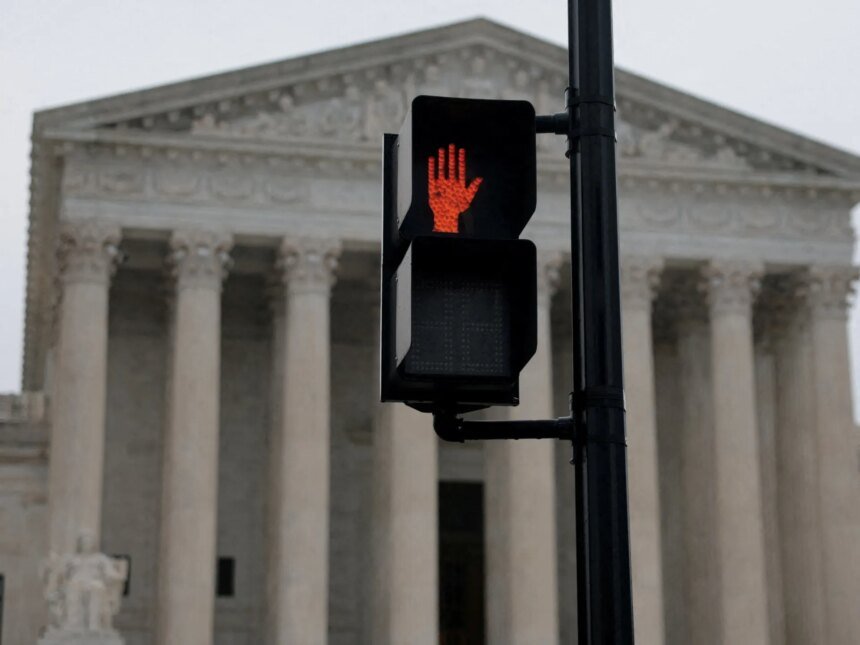
In a move that represents a new blow to US President Donald Trump’s anti-immigrant policies, the US Supreme Court invalidated his administration’s executive order restricting the right to automatic citizenship for children born in the United States.
Yesterday, Tuesday, the US Supreme Court upheld birthright citizenship, which grants citizenship to almost all people born in the United States, by a majority of 6 votes to 3 against.
According to the American newspaper The Washington Post, the court’s decision puts an end to one of the most stringent issues in Trump’s anti-immigration agenda, despite his ability to impose hundreds of other restrictions that were upheld by the court and entered into force.
Below are the most important points related to this topic:
What is “birthright citizenship”?
“Birthright citizenship” means the legal principle that grants automatic citizenship to any person born on the territory of the United States, except in limited cases and within a very narrow scope, most notably the children of foreign diplomats.
This concept was officially codified in the Fourteenth Amendment to the US Constitution, which was added after the American Civil War.
The aim of drafting this constitutional amendment was to ensure that black-skinned citizens – including former slaves – enjoy the protection and equality guaranteed by citizenship.
How did the story start?
On the first day of Trump’s second term, he issued an executive order revoking the birthright of citizenship for children of undocumented immigrants and foreign residents with temporary legal status, including tourists and students on visas.
In doing so, Trump fulfilled a long-standing promise he made to himself to restrict this right, which he repeatedly described as a “trick” that attracts immigrants to America.
This step sparked widespread dissatisfaction and opposition because it conflicted with the American Constitution, which guaranteed it more than 150 years ago.
Immediately after the executive order was issued, immigration and civil rights organizations and more than 20 US states responded by filing lawsuits, including at least four major cases. These lawsuits led to rulings from lower courts that prevented these restrictions from entering into force nationwide.
The case decided by the Supreme Court yesterday, Tuesday, dates back to a class action lawsuit called “Barbara v. Trump,” which was filed in the state of New Hampshire to protect the rights of all children born in the United States.
What are the effects of the decision?
According to the decision issued by the Supreme Court on Tuesday, Trump’s executive order has become invalid and cancelled, and American states can continue to issue birth certificates to children born on their soil, according to the New York Times.
The newspaper indicates that under the decision also, parents will not face any changes or legal obstacles when applying to obtain identification documents for their children, such as birth certificates, passports, and social security numbers, as the American birth certificate will remain conclusive evidence of citizenship as it was.
This decision affects the lives of thousands of Americans, as data from the Pew Research Center indicates that more than 6 million people born in the United States live with parents who are undocumented immigrants. This number includes about 4.6 million children under the age of 18, and about 1.4 million adults born in America.
What are its political repercussions?
With the wide support it received, Republican voices rose calling for measures to restrict birthright citizenship, and saw the decision as an absolute disaster.
American media indicate that opinion polls in this regard confirm that a majority of Americans support the right to automatic citizenship for those born on American soil, and this includes most Democrats and about 40% of Republicans.
The Washington Post believes that birthright citizenship did not prevent the Trump administration from boasting of its successes in combating what it calls “birth tourism.”
As for the New York Times, it says that the ruling to cancel Trump’s executive decision in this regard eliminated one of the most extensive points in the immigration agenda set by the Trump administration. The newspaper believes that this ruling may push Republican lawmakers to demand a constitutional amendment to restrict this right, which is a legislative battle that involves many obstacles.
House Speaker Mike Johnson expressed his dismay when reporters informed him of the Supreme Court’s ruling regarding birthright citizenship. He stated that he needed to read the text of the ruling, adding that this right had been subjected to “blatant abuse in recent years.”
Johnson expressed his disappointment with the court’s decision, and said that it would lead to “serious challenges in the future” that Congress must find ways to address.
The Washington Post also quoted Kevin Roberts, president of the Heritage Foundation – a conservative think tank – as saying that the decision represents “high treason to the republic” that reduces the value of American citizenship, and called for a constitutional amendment to abolish it.
Setback or limited loss?
On the other hand, immigration researchers point out that this ruling represents a setback, but it is limited, as the Trump administration was able to radically reformulate immigration policy, noting that it was able to impose more than 700 restrictions on immigration since the start of Trump’s second term.
Just last week, the Supreme Court ended temporary humanitarian protection for more than 350,000 Haitians and Syrians, sparking what some jurists describe as the largest “dedocumentation” of migrants in modern history.
The New York Times quoted Stephen Yale Lauer, a researcher in immigration laws at Cornell University, as saying, “Despite this seemingly historic loss, the Trump administration is winning its war on immigrants.”
“As a result, international tourist numbers have declined, and American companies are no longer able to hire the workers they need,” he added.
Despite the court’s 6-3 decision, birthright citizenship still raises concerns on the American right. The Washington Post notes that the judges dissenting in the court expressed concern about the negatives related to repealing the executive order, with Justice Samuel Alito writing, “The court’s interpretation maintains a strong incentive to enter or remain in this country illegally.”
According to the newspaper, the judges’ concern is that undocumented immigrants can have children who automatically become American citizens, which represents a “winning lottery ticket in many parts of the world,” according to the newspaper, which noted that children’s acquisition of citizenship complicates efforts to deport parents.
The Washington Post also quoted Judge Brett Kavanoff as saying that the Americans who drafted and ratified the Fourteenth Amendment did not anticipate “the issue of temporary visitors giving birth to children in the United States,” a phenomenon that has come to be known as “birth tourism.”