Published on 6/30/2026
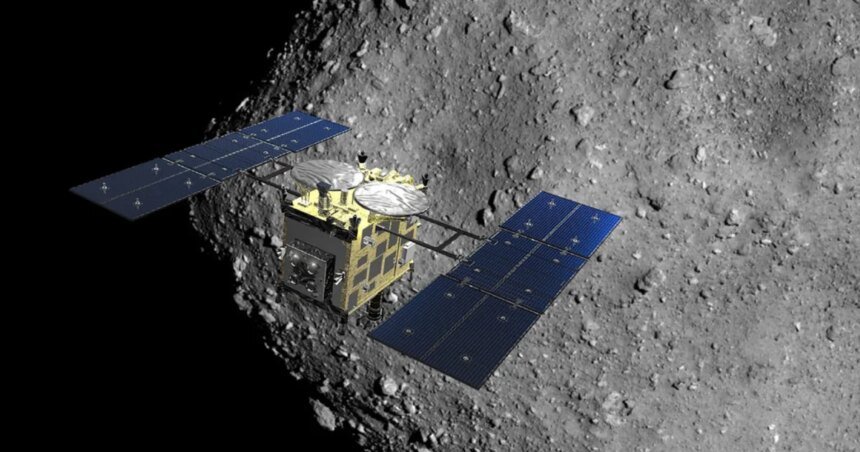
Japan’s veteran space probe Hayabusa2 is preparing to embark on one of the most daring space operations in the history of modern cosmic exploration. On July 5, 2026, the probe will fly at great speed next to the near-Earth asteroid “Torifune” to capture unique images and scientific data.
This ambitious space saga began when the Japanese Space Agency “JAXA” launched this probe in 2014, where it succeeded in its primary mission of collecting samples from the asteroid “Ryugu” and returning them to Earth with impressive success in 2020.

Instead of referring him to retirement after this historic achievement, scientists decided to extend his mission to continue sailing in deep space, heading today towards a complex self-navigation test that foretells a new future for exploring nearby celestial bodies.
Read also
list of 2 itemsend of list
The challenge of self-navigation on the edge of danger
This highly anticipated maneuver is one of the most difficult technical challenges faced by a spacecraft of this class. The probe will pass only between one and ten kilometers from the surface of the asteroid, moving at a breakneck speed of up to 5.3 kilometers per second.
This lightning speed means that the observation window will last only a few seconds, requiring extremely precise and complex autonomous guidance systems to avoid cosmic dangers.
Regarding this achievement, Satoshi Tanaka, a scientist and official at the Japanese Aerospace Agency (JAXA), said during a recent scientific presentation: “This is one of the closest asteroid encounters ever attempted. By combining advanced navigation techniques with the engineering capabilities of the probe, we made the flyby possible at a distance of only one kilometer.”
This amazing success reflects more than a decade of engineering development and accumulated experience at the agency.
A new monster in the mysterious asteroid park
Although astronomers have tracked the asteroid Torrevoni, which is about 450 meters wide, its true nature and internal structure are still completely mysterious. No one knows if it is a single solid mass, or a loose collection of rocky debris.
This unknown both excites the scientific community and doubles the danger of the mission. In this regard, Patrick Michel, the principal investigator for the European Space Agency’s Hera mission and a member of the Japanese probe’s scientific team, explained to Space, saying: “It is a risky operation because it was not planned in advance.”

He added, expressing his passion for discovery: “We will discover what this asteroid looks like. Every time we see a new asteroid, we are amazed, and we are about to discover another monster to put in the asteroid zoo.”
Planetary defense and targets that extend beyond the horizon
The importance of this lightning flyby does not stop at the limits of studying a single asteroid, but rather extends to contributing to the development of global “planetary defense” strategies to protect the Earth from the threat of future collisions by testing rapid reconnaissance and assessment capabilities, thus complementing the success of the “DART” mission of the American Space Agency (NASA) in 2022.
This confrontation will not be the last stop in the probe’s busy journey; Its ultimate goal is to reach the extremely small asteroid KY26 (1998 KY26) in 2031, which is only 11 meters wide, in another historic attempt to land on it.

These continuous journeys remind us of the philosophical essence of science, which lies in the constant challenge of the unknown. The probe that was designed for a specific mission continues today, proving that the human mind is not limited by distance.
Space exploration is not just a static technological race, but a living embodiment of man’s eternal curiosity and sublime intellectual value. We do not explore rocks floating in the dark, but rather search for answers to the story of our existence, stressing that science is the finest bridge that connects our humble present to the infinite breadth of the universe.