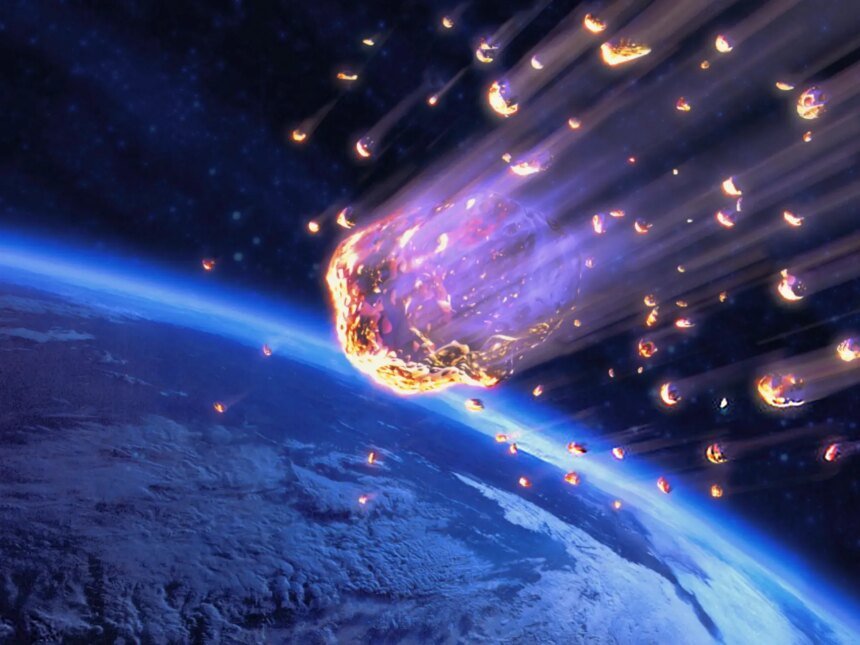
Luxembourg hosted an international celebration on the occasion of “Asteroid Day”, organized by the Luxembourg “Asteroid Foundation” with the participation of scientists from the European Space Agency (ESA), the American Space Agency (NASA), astronauts and experts in planetary defense, to discuss a question that is no longer theoretical as it was years ago: Is humanity truly capable of protecting the Earth from a dangerous asteroid collision?
But the real challenge is no longer the giant asteroids, but rather the smaller ones that may surprise Earth without sufficient warning. That is why the festival sessions focused on a more pressing question: Can humanity detect dangerous objects before they are on a collision course?
Read also
list of 2 itemsend of list
Scientists explained that more than 95% of the giant asteroids with a diameter of more than one kilometer have become known, and their orbits are accurately calculated, and none of them pose a threat to Earth in the coming centuries.

The real source of concern is asteroids that range between 30 and 140 meters in diameter. Despite their relative smallness, they are capable of destroying an entire city, as happened in the Tunguska explosion in Siberia in 1908.
The speakers stressed that millions of these objects are still unknown, so automated observatories, celestial surveys, and artificial intelligence technologies have become the first line of defense, because the best way to protect the Earth is not to have advanced means of interception, but rather to detect the danger years before it arrives.
Patrick Michel… For the first time in history… man changed the orbit of a celestial body
French asteroid scientist Patrick Michel, director of research at the French National Center for Scientific Research (CNRS), and one of the most prominent scientists of the European Space Agency’s Hera mission, was one of the most attended speakers at the symposium.
He explained that NASA’s DART mission in 2022 was not just a space experiment, but rather a historical moment that proved that humans can practically change the orbit of an asteroid in space, but the mission is not over yet.

Here comes the role of the European Hera probe, which is expected to arrive at the Didymos and Demorphos asteroid system in late 2026, to measure the size of the crater left by the Dart collision in 2022, study the internal structure of the asteroid, and find out why it responded to the collision in this way.
Michel pointed out that understanding the composition of asteroids is no less important than knowing their locations, because the method of defending them depends on their internal nature. A solid, rocky asteroid does not behave in the same way as a brittle asteroid that resembles a pile of rubble held together by gravity.
Asteroids… are not only a danger, but a treasure from the history of the solar system
The seminars were not limited to collision scenarios, as cosmic geologists focused on the fact that asteroids represent the oldest material remaining since the birth of the solar system about 4.6 billion years ago.
Therefore, each sample returned by spacecraft, such as the Japanese Hayabusa-2 or the American OSIRIS-REx, is like opening a time capsule that reveals the conditions in which the planets were formed, and may explain how the first water and organic compounds reached Earth.

Experts also discussed the future of asteroid mining, as some objects contain large quantities of nickel, iron, and platinum, in addition to water ice that can be converted into hydrogen and oxygen fuel in the future, to support trips to the moon and Mars without the need to release all the fuel from Earth.
Between Tunguska and NC1 1997… how much has humanity changed?
118 years ago, no one knew that a celestial body was heading toward Earth until it exploded over Siberia. Today, scientists have been able to follow the asteroid “NC1 1997” since its discovery in 1997, accurately calculate its orbit, prepare to monitor it with radar and telescopes before it passes, and even discover that it is a slowly rotating bilobed body, without posing any danger.
This is perhaps the most important message that emerged from this year’s World Asteroid Day symposium: that we are not able to prevent all asteroids from existing, but we now have a real opportunity to prevent the disaster if we discover them in time.

Within a single generation, humanity has moved from fearfully watching the sky to planning to defend it.
While these rocks continue their silent journeys through space, man continues his most important journey: to understand the universe enough to protect his only home, and to turn knowledge into the first line of defense for planet Earth.