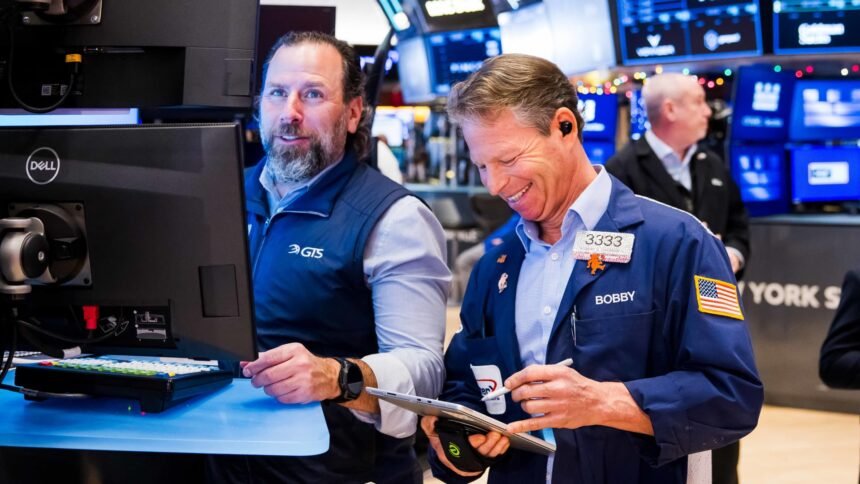
Traders work at the New York Stock Exchange on Dec. 29, 2025.
NYSE
Small-cap U.S. stocks are capping off one of their strongest first halves in decades. But this is not your ordinary small-cap boom led by traditional businesses linked to the economic cycle.
This run, like the one going on with their larger-cap peers, has been driven by the rapid buildout of AI infrastructure, as spending spreads beyond the largest technology companies to a broader network of suppliers.
Investors believe the small-stock rally can broaden out beyond tech and continue, as long as interest rates stay in check.
The Russell 2000 Index has surged more than 21% this year, putting the benchmark on track for its best first-half performance since 1991. The advance marks a sharp turnaround after years of underperformance versus large-cap peers.
“It’s both a valuation catch-up story and a fundamental story,” said Amy Zhang, portfolio manager at Alger. “The valuation gap was so wide that a truck can drive through it. At the same time, fundamentals are improving in small caps and I think that’s why it’s causing the broadening trade.”
Semiconductor and semiconductor-equipment companies have been the biggest winners, underscoring how the AI investment boom is rippling through the broader market. Chip-related companies account for 16 of the Russell 2000’s 50 best-performing stocks this year, including Aehr Test Systems, Ichor Holdings and MaxLinear, which have all rallied more than 400%.
Rather than competing directly with industry leaders like Nvidia, many of these smaller companies are benefiting from rising demand across the AI supply chain. As chipmakers and cloud providers ramp up spending on AI infrastructure, suppliers of semiconductor equipment, components and connectivity solutions are seeing the gains trickle down, amplifying revenue and earnings growth for companies with much smaller market capitalizations.
“I think a significant part of the small cap story is tied to AI,” Zhang said. “The impact of AI investment trickles down from large-cap leaders to small-cap companies. The effect will be more amplified for small-cap companies, in terms of revenue and probability growth.”
More Than Just AI
While AI has been a key driver of the rally, strategists say the small-cap rebound has been supported by a broader set of fundamental tailwinds and can continue.
“Small-cap leadership has been notable amid the mega-cap-driven bull market, although small caps have meaningful exposure to semiconductors and technology hardware,” said Adam Turnquist, chief technical strategist at LPL Financial. “Building fundamental strength has also helped offset headwinds from higher rates.”
Consensus forecasts for Russell 2000 companies’ 2026 earnings growth have climbed to 38% from about 23% at the start of the year, according to LPL, reflecting growing optimism that profit growth is broadening beyond the largest technology companies.

Russell 2000 year to date
Turnquist also pointed to several other catalysts that could continue to support the asset class, including small caps’ greater exposure to the U.S. economy, expectations for increased merger-and-acquisition activity — particularly in the pharmaceutical and biotechnology industries — and tax incentives designed to encourage capital investment.
Higher rates a threat?
The biggest threat to the small-cap rally may be the same force that held the group back for years: higher interest rates.
The Federal Reserve next meets July 28-29, with traders pricing in about a 30% chance of a rate increase, according to CME Group’s FedWatch tool. By September, markets see more than a 60% probability of at least one quarter-point hike.
Higher borrowing costs pose a particular challenge for smaller companies, which generally carry more floating-rate debt and face greater refinancing needs than their large-cap peers. Bank of America estimates that every additional 25-basis-point hike would reduce Russell 2000 operating earnings by about 2%.
“This could challenge the expected 4Q profits acceleration (and sentiment) in small caps, which have the most refi risk,” Bank of America strategists said in a note.
Even so, many investors believe the worst of the tightening cycle is over. The Fed raised interest rates by a cumulative 500 basis points between March 2022 and mid-2023, one of the most aggressive hiking campaigns in decades.
“We’re probably close to peak inflation and peak rates,” Zhang said. “We had significant headwind the last five years, and I think the headwind is going to abate and turning into a tailwind.”
—With reporting by Deena Zaidi