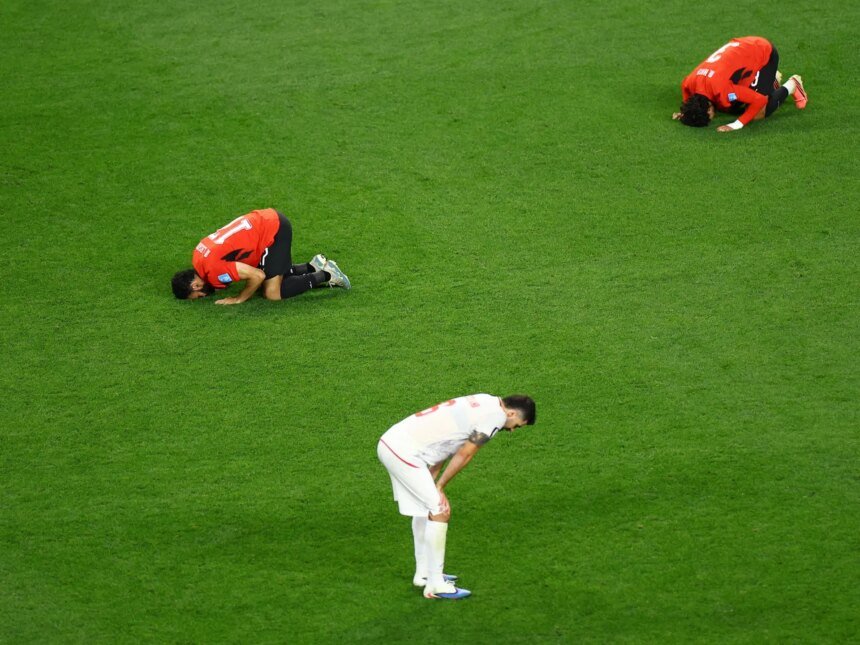
Football fans rarely pay attention to the pitch, and fans often only notice the grass when a player stumbles awkwardly, the ball suddenly loses its path, or faint spots appear that distort the symmetry of the green rectangle.
But in the World Cup, the field is no longer just a green background in the stands or on television screens, but has turned into a huge engineering and agricultural project, because the tournament is held in countries and cities that differ in their climate, humidity, temperature, and the degree of exposure of their stadiums to the sun.
Read also
list of 4 itemsend of list
The playing field…a very complex art and science
In the 2026 World Cup, Reuters explains that the stadium’s grass is not just a carefully mowed green layer, but rather part of a complete subsurface system consisting of:
- A sandy root layer allows for compaction and moisture retention.
- Coarse bottom layer to speed up drainage.
- Pipe network for drainage and ventilation.
- In some stadiums, there are heating or air and water control systems.

What the spectator sees as a smooth surface is in fact a “living organism” placed on top of an engineering structure designed to deal with rain, heat, pressure and friction, while at the same time maintaining the speed of the ball and the stability of the player’s feet.
Contrary to popular perception, grass is not planted next to the stadium and then left to grow in its place. Rather, it grows for months on specialized farms, then is cut into huge slices and transported as if it were a sensitive commodity that needs a cold chain.
After the grass matures, it is harvested in rolls that resemble carpets, and some strips may be transported in refrigerated trucks because the grass becomes very sensitive to heat after it is uprooted, and these rolls may travel thousands of kilometers before they are spread on the World Cup stadium.
Therefore, there is no “uniform mixture” of grass for all stadiums, but rather it varies according to the climate. Cooler or partially covered courses tend to use a mixture of ryegrass and Kentucky bluegrass; The first germinates quickly and recovers from damage, while the second extends under the soil and helps repair voids.
As for playgrounds that are hotter and exposed to the sun, species such as Bermuda grass are suitable, because they are more tolerant of heat and drought. Therefore, FIFA is not looking for a complete vegetation match, but rather a similar playing feel despite the difference in the type of grass from one city to another.
The grass… the focus of the fairness of the match
The importance of grass is not only about aesthetics, but it is selected, planted and managed as a high-performance surface, not just an ornamental plant. Scientific American magazine explains that the failure of the playing surface may change the game itself and control its outcome.
This is related to what is known as (footing), that is, the stability of the foot during play, the speed of the ball on the ground, its bounce, and the ability of the field to recover after slips and collisions.
In this sense, the surface becomes part of competitive justice, because a team playing on a faster, harder or drier surface may face a practically different match than another team playing on a softer or wetter surface. The same team may perform differently simply because the playing field is different.

America’s stadiums learn about world football
This task becomes more difficult in the 2026 World Cup because some of the hosting stadiums were not primarily designed for football in its international form nor to receive long-lasting natural grass. Rather, they were built for different uses, most notably American football, hosting concerts and major events, or relying on artificial turf that can withstand the pressure of repeated commercial and sports use.
The Associated Press reports that 8 of the 16 World Cup stadiums typically used artificial turf – including 7 in the United States and one in Canada – and 5 of these stadiums are completely or partially covered or have open-and-close roofs, which makes introducing natural turf into them a complex task.
Natural grass needs light, air, water, drainage and a stable root system, while many of these stadiums are built around a completely different logic: huge ceilings, high stands, changeable pitches and busy usage schedules between sports and entertainment.
At Lumen Field in Seattle, a stadium typically used in the NFL, the switch to natural grass wasn’t just a matter of removing an artificial surface and replacing it with a green one. New box-like infrastructure was added over the original floor to provide drainage and ventilation, then covered with more than 25 centimeters of sand, before spreading local natural grass and reinforcing it with synthetic fibres.
Sewing the playing field!
The complexity does not stop at preparing the layers, but sometimes it reaches the point of “stitching” the grass onto the playing field.
Some stadiums use specialized machines that plant millions of synthetic fibers vertically within the root area, so that the grass roots wrap around them over time, making the surface more cohesive and able to resist tearing resulting from slips and violent rotations.
This stitching is not visible to the audience from the stands, but it appears in crucial moments: when a defender slides to clear the ball without a large piece of the ground coming off, or when a player turns quickly under pressure from the opponent without his foot losing its stability, or when the field can withstand more than one match in a short period.

Water and the length of the grass… engineering the rhythm of the match
Grass maintenance is not only an aesthetic task in this context, as the amount of water that the field receives may change the speed of the football match itself.
A wet surface allows the ball to slide more quickly across the ground, while dryness makes passes slower and heavier. But excessive water may make the floor stressful for the players and affect their balance and ball movement. Therefore, watering before the match or at half-time becomes part of managing the rhythm of play, and not just a routine procedure.
The same goes for mowing the lawn; The height of the green hair is not a small detail, because the length of the grass affects the ball’s contact with the ground, the speed of short passes, and the players’ ability to control under pressure.
Reuters explains that the grass in major stadiums is usually cut to a height of between 20 and 30 millimeters to maintain a consistent speed of play, and then after each match a careful restoration process begins of the holes and tears left by slips and hard tackles.
Test with the foot before the eye
Despite all this engineering, the success of a pitch is not only measured by its appearance, but by how the players feel on it. Some French stars complained about the hardness of the ground in New York, New Jersey, and had to change their shoes, while the Vancouver stadium received praise for its flexibility and the smooth movement of the ball on it, which reflects the paradox that the field may appear ideal to the eye, but it is not so to the foot.
These experiments, accompanied by research into hybrid turf technologies and irrigation and drainage systems, indicate that the future of stadiums is moving towards surfaces that are more able to adapt to intense use and environmental requirements at the same time.
In the end, the grass remains the hidden hero of the match; If he does his job properly, no one feels it, but he is present in every touch, working silently to make football as fluid, fair and enjoyable as the fans want it to be.