Published on 6/29/2026
The confrontation between Morocco and the Netherlands in the round of 32 of the World Cup in 2026 has brought the issue of dual nationality players back to the forefront of discussion in the Netherlands, in light of the increasing number of players born in Europe who choose to represent the “Atlas Lions” at the expense of European teams.
The match, scheduled for Tuesday morning, goes beyond the limits of sporting competition, given the human and cultural relations that unite the two countries, in light of the presence of a large Moroccan community in the Netherlands, as well as the emergence of a number of players who received their football training in Dutch schools before choosing to represent Morocco.
Read also
list of 2 itemsend of list
Players born in the Netherlands and chose Morocco
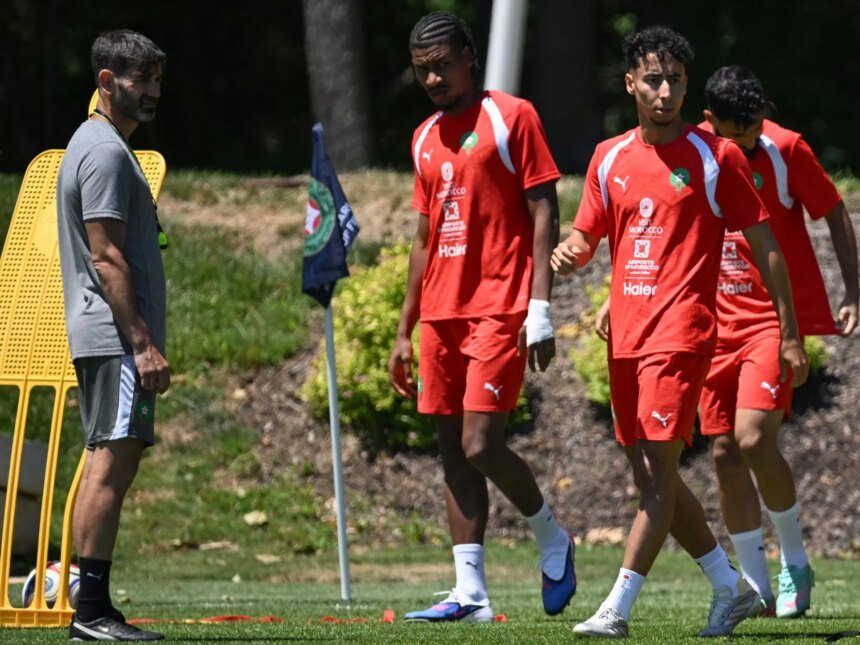
The Moroccan national team includes a number of players born outside the country, including Noussair Mazraoui, Anas Salahuddin, and Sofiane Amrabat, who were born in the Netherlands before choosing to represent the Moroccan national team.

Some of these players had previously carried the colors of the Dutch national teams in the age groups, before deciding to play for the “Atlas Lions” team.
This comes at a time when there are increasing indications that Shaquille van Persie, the son of former Dutch star Robin van Persie, may choose to represent Morocco in the future, given his mother’s Moroccan origins.
Is Morocco witnessing a “reverse migration” of talent?
The choice of a number of dual national players to represent Morocco at the expense of the Netherlands or other European teams is no longer just an individual decision or a passing exception. Rather, it has become a recurring phenomenon that raises questions about whether football is witnessing a kind of “reverse migration of talent.”
For decades, European teams have benefited from players of Moroccan origin who received their training in European academies, but recent years have witnessed a remarkable transformation, as an increasing number of these players have begun to prefer to carry the “Atlas Lions” shirt.
This is due to several factors, most notably the development of the Moroccan national team’s sporting project, which is now presenting itself as a team capable of competing globally after reaching the semi-finals of the World Cup in 2022 and winning the African Cup of Nations in 2025, as well as its technical stability and high position in the global rankings.
Family and cultural affiliation is also no longer a secondary factor in players’ decisions, as many of them confirm that representing the country of their fathers and grandfathers forms part of their personal identity, even if they grew up and were educated in Europe.
On the other hand, some European teams no longer represent the only or most attractive option, especially for players who find in the Moroccan national team a real sporting opportunity in addition to their sense of belonging.
Controversial statements
Former Dutch national team player Rafael van der Vaart sparked widespread controversy during the past months when he spoke about the players who choose to represent Morocco.
He said that “all Moroccans who cannot find a place in the Netherlands go to play with Morocco,” statements that sparked widespread criticism in sports circles.

However, the development witnessed by the Moroccan national team in recent years, in addition to its continental and global results, has led many to consider the players’ choices linked to the sporting project as well, and not only to international playing opportunities.
Belonging before sporting considerations
A number of former players confirmed that choosing to represent Morocco is not only related to the sporting aspect, but also to factors of identity, belonging, and family roots. Ibrahim Afellay, the former Dutch international player who played 53 matches with the Netherlands national team, said that he will support Morocco during the confrontation.
He explained: “My heart is with Morocco. My roots are there, my parents are Moroccan, and all my family members live in Morocco.”
As for Adel Ramzi, the former Moroccan international and current coach of the Netherlands U-19 national team, he confirmed that he finds it difficult to choose the party he will support.
He said that Morocco is his country to which he is proud to belong, but he also considers the Netherlands a part of his life after he lived there for many years and received his professional opportunities.
Morocco coach…they are Moroccans first
For his part, Moroccan national team coach Mohamed Wehbe stressed that players of Dutch origins are “Moroccans above all.”
He said that these players want to win for Morocco, not with the aim of defeating the Netherlands, stressing that the main motivation for them is to represent their country and defend its colours.
Wehbe, who was born in Belgium, added that he understands the feelings of dual nationality players, especially when they face the country in which they grew up or that gave them great opportunities in their career.
Political playground
The discussions were not limited to the sporting aspect, as the issue entered the political arena in the Netherlands.
Far-right politician Geert Wilders sparked widespread controversy after he published an image generated by artificial intelligence in which he appeared as a referee expelling Moroccan players with a red card, in a move that sparked widespread criticism.
On the other hand, the Dutch Football Association called for the match to be dealt with in a sporting spirit, stressing the depth of the ties between the two countries.
The Secretary-General of the Dutch Federation, Gaes de Jong, said that sports and humanitarian relations between Morocco and the Netherlands are present at various levels of football, stressing that the match must be an occasion to highlight the values of respect, solidarity and fair play.
Between identity and roots on the one hand, and the sporting project and competitive ambition on the other hand, the confrontation between Morocco and the Netherlands appears to be more than just a World Cup match, as it reflects a shift in the choices of a new generation of dual nationality players, for whom European formation alone is no longer sufficient to determine their football affiliation.