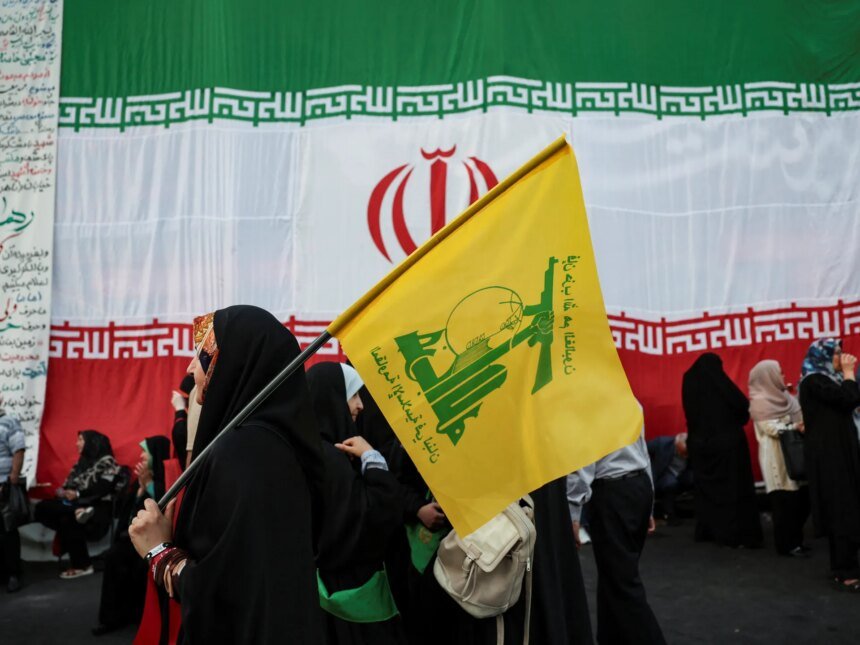
The framework agreement between Lebanon and Israel brought the Hezbollah weapons issue back to the forefront of the Iranian debate, after its provisions linked the gradual Israeli withdrawal from southern Lebanon to verifying the disarmament of “non-governmental actors,” led by Hezbollah.
Reuters reported that the agreement, which was brokered by America and signed by the Lebanese and Israeli ambassadors in Washington, includes a conditional Israeli withdrawal from southern Lebanon, in exchange for verification of the disarmament of non-governmental actors.
It was also reported that Israeli Prime Minister Benjamin Netanyahu praised the agreement, saying that it allows the continued Israeli presence in southern Lebanon if Hezbollah does not disarm.
In the same context, Israeli Defense Minister Yisrael Katz said that “there is no withdrawal without disarmament,” while Hezbollah Secretary-General Naim Qassem rejected the agreement, and considered it “non-existent,” “humiliating,” and a “relinquishment of sovereignty.” He said that linking the Israeli withdrawal to the party’s disarmament crosses “all red lines.”
Two days after the agreement was announced, Israel said that it had destroyed Hezbollah’s underground infrastructure in the town of Majdal Zoun in southern Lebanon.
Reuters reported that the operation targeted a 200-meter tunnel containing weapons and missile launchers, and that Washington was informed in advance of the operation. Hezbollah described the Israeli strikes as a “flagrant violation” of the ceasefire.

Washington understanding
These developments come after an Iranian-American understanding that spoke of an immediate and permanent cessation of military operations on all fronts, including Lebanon.
Axios quoted American, Israeli and Lebanese sources as saying that one of the motives for the Lebanese-Israeli agreement talks is to reduce the influence of Iran and Hezbollah in Lebanon.
Lebanese Parliament Speaker Nabih Berri, a key Hezbollah ally, criticized the agreement and described it as a “dictation,” warning that it could spark internal Lebanese divisions. He said that real progress regarding the Israeli withdrawal from Lebanon can only be achieved through American-Iranian negotiations.
A detailed official Iranian position on the agreement has not yet been issued, but the interventions of Iranian experts to Al Jazeera Net provide different readings of Hezbollah’s position in Iranian accounts, and the limits of accepting any discussion about its weapons.
Declining deterrence
The Iranian expert specializing in Iranian-Lebanese relations, Muhammad Khawajovi, believes that Iran’s deterrence strategy over the past two decades was based on three pillars: the missile and drone program, the nuclear threshold, and the network of allies known as the “Axis of Resistance.”
Khawajoi told Al Jazeera Net that the American attack on Iranian nuclear facilities last June “effectively overthrew the idea that approaching the nuclear threshold, that is, 60% uranium enrichment, is sufficient to create a real deterrent force for Iran.”
He adds that Israel, after the “Al-Aqsa Flood” operation on October 7, 2023, entered into an attempt to settle the score with the axis of resistance led by Tehran, and “succeeded to a large extent in this endeavor.”
According to Khawajoi, the weakening of Hezbollah and Hamas, and the fall of Bashar al-Assad’s regime, led to “the collapse of the third pillar in the Iranian deterrence equation.”
But he adds that Hezbollah, although in the current circumstances it has lost its role as a direct deterrent tool, “still represents a strategic capital for Tehran,” because the dynamics of the region may allow in the future to revive and strengthen the allied network.
Regarding the framework agreement, Khawajoi linked it to the first clause of the Iranian-American understanding, saying that Tehran made a pledge in it to end hostilities, not only on behalf of itself, but also on behalf of its allies in the axis of resistance.
But he believes that the problem is that Israel has “disavowed” this clause, adding that if Tel Aviv insists on continuing escalation and military operations, especially in Lebanon, “this entire pledge will be in vain.”

Strategic depth
For her part, West Asian affairs researcher Hoda Yousefi says that Hezbollah’s presence in southern Lebanon gives Iran the possibility of extending its strategic depth to the borders of Israel without expanding its geographical borders.
Yousefi compares this to what she considers an opposite Israeli path by building a network of security relations in the Gulf through what is known as the Abraham Accords to besiege Tehran, saying that “the two parties are moving with the same logic, but through two different paths.”
She explains to Al Jazeera Net that Hezbollah adds to Israeli military calculations the cost of confrontation on two fronts, as northern Israel becomes, in any tension between Tehran and Tel Aviv, vulnerable to the threat caused by the party’s missiles and drones. She adds that deterrence here is not based solely on shooting, but rather on “the believability of the threat.”
As for journalist and political analyst Reda Ghabishawi, he presents a more conservative approach in linking Hezbollah’s weapons directly to the Iranian deterrence system. He told Al Jazeera Net that “it cannot be certain” that Hezbollah’s weapons are part of Iran’s deterrence, noting that Tehran has been subjected to repeated attacks, but Hezbollah did not launch an attack on Israel in response.
Ghabishawi cites the June 2025 war, saying that despite the start of the first Israeli war on Iran and lasting 12 days, Hezbollah did not enter the war. However, he confirms that Hezbollah and the Islamic Republic are “allies,” and that the party enjoys the support of Tehran, considering that the allies’ support of each other is natural.
Internal debate
The positions of the three experts intersect at a fundamental point: Iran does not want to disarm Hezbollah, but prefers to frame the issue as an internal Lebanese matter.
Khawajoi says that Tehran welcomes any approach that discusses the arms issue if it is presented as an internal Lebanese matter, to be dealt with within the frameworks of the National Charter and through a dialogue that crosses sects and political forces.
He believes that including the file within the “National Defense Strategy,” an idea proposed by former Lebanese President Michel Suleiman in 2008, is a path that is supported by both Hezbollah and Iran.
But Khawajoi stresses that unilateral American and Israeli pressures disrupted these paths, and prevented the file from being included in the mechanisms of Lebanese internal dialogue.

As for Yousfi, she says that Iran, from a strategic standpoint, “does not see any scenario for disarming Hezbollah as a desired option,” but in its diplomatic speech it presents the issue as an internal Lebanese file. She adds that the complete Israeli withdrawal from southern Lebanon alone is not enough to change the Iranian calculation, because the “structural lack of trust” towards Israel will remain.
In turn, Ghabishawi believes that Iran could accept an internal Lebanese dialogue about Hezbollah’s weapons, provided that this takes place with the approval of the party itself. He recalls the experience of the Lebanese national dialogue in 2006, headed by Nabih Berri, when Hezbollah’s weapons were one of its most prominent axes.
But he confirms that Hezbollah has repeatedly declared that its weapons are a “red line,” and that it will not accept a complete disarmament, although it may discuss the “how” of weapons, the areas of their deployment, and cooperation in this context. He concludes that what Israel could not achieve in a military war “Hezbollah will not bring to the dialogue table.”
Tehran options
According to the three interventions, Tehran’s options do not appear to be limited to escalation or acceptance, as Khawajoi believes that Tehran does not have a wide margin of maneuver to directly intervene in the war on Lebanon, especially since direct Iranian strikes against Israel did not produce, according to his opinion, the required balance of deterrence.
He believes that the Iranian strategy is mainly based on pressuring Washington, as the only party capable of influencing Israel, pointing to potential pressure tools such as the Strait of Hormuz, American bases in the region, and obstructing the paths of final negotiations. He describes the Iranian tactic as based, in concert with Hezbollah, on “buying time” and imposing a long-term “war of attrition.”
As for Yousfi, Iran is likely to use a combination of paths, led by “strategic patience,” in addition to letting Hezbollah manage the confrontation within Lebanon, and using political pressure through allies to slow down any disarmament process from within Lebanese institutions.
Yousefi rules out direct Iranian escalation in the short term, due to what she describes as Hezbollah’s current structural weakness, internal economic pressures in Iran, and the sensitivity of the nuclear issue.
As for Ghubishawi, he believes that Tehran’s position on Hezbollah passes through the position of the party itself, and that any decision it takes will be respected and accepted by the Islamic Republic. But he confirms that Tehran will use all its political and military tools to support Hezbollah’s position. If the party refuses to disarm, which is what Ghabishawi expects, Tehran will support it.
Waiting position
Until now, there is no detailed official Iranian formula announcing whether Tehran considers the agreement a direct circumvention of its understanding with Washington. However, the three interventions obtained by Al Jazeera Net show a discrepancy within the unofficial Iranian reading, as Khawajoi places the agreement in the context of the decline of the pillars of Iranian deterrence and the attempt to fortify the “axis of resistance.”
Yousfi views it as a path that might give Hezbollah a short-term breathing space but threatens its strategic function, while Ghabishawi reserves the right to consider the party’s weapons a direct part of deterring Iran, but stresses that Tehran will support Hezbollah’s position if it refuses to disarm.
While Washington says that the agreement aims to consolidate the authority of the Lebanese state and reduce the escalation, and Israel says that the withdrawal is linked to disarmament, Hezbollah maintains that any Israeli withdrawal must be unconditional, and that the arms issue cannot be imposed from the outside.