Published 05.45

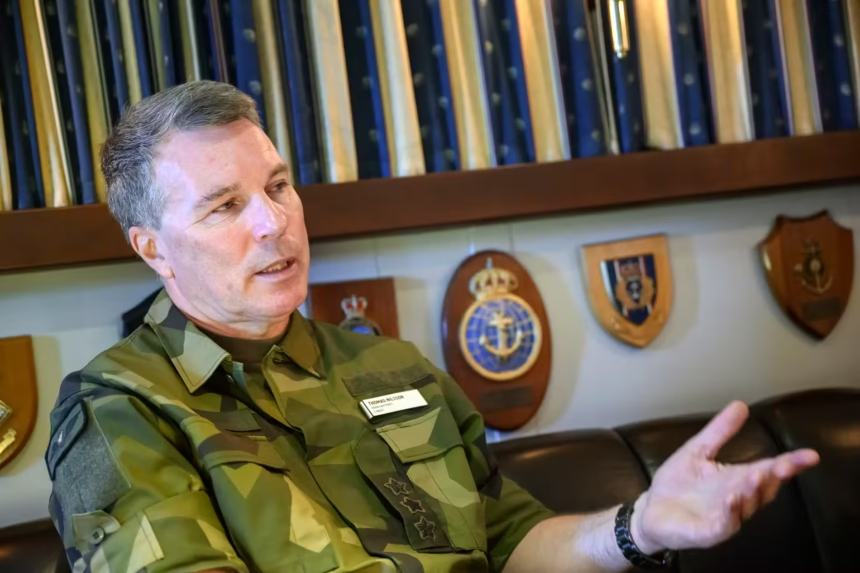
In the past six months, Russia has become more aggressive and risk-prone, says Must chief Thomas Nilsson.
At the same time, he speaks of great human losses for the country, of over a million dead and seriously wounded.
– In my eyes, it is unimaginable, he says.
When Must, the military intelligence and security service, presented its report for 2025 at the beginning of the year, it was pointed out that Russia is taking increasing risks. Now, six months later, the situation has gotten worse, according to Thomas Nilsson.
– Overall, I unfortunately think it is getting worse. It’s going in the wrong direction, he says.
He mentions Russian violations of airspace in Finland and Estonia, the blowing up of a railway in Poland, stepped-up attacks on civilian targets in Ukraine and a sharpened Russian narrative that it is in a strategic conflict with the West.
– We hear more and more Russian representatives, including Putin and Foreign Minister Lavrov, who say that the West is planning attacks against Russia. That it is a bigger plan where they want to overthrow Russia.
High price
When the temperature is slowly turned up, it is not always noticeable, he says.
– But whatever it is, the temperature is a little too high for that poor frog.
But Russia’s war comes with great human losses for the country.
– In my eyes, it is unimaginable. It is impossible to imagine that a normal democratic country could accept that kind of losses and the price you pay, says Nilsson.
When asked if there are any concrete figures for the Russian losses, Thomas Nilsson answers:
– No, but we have pretty much confirmed, a little depending on how you count, that in total you have passed one million Russians in losses. We are talking fallen and wounded, those who can no longer participate in the battle.
The losses are also financial. In an interview with the Financial Times this spring, Thomas Nilsson said that Sweden has intelligence that indicates that Russia is systematically manipulating data on inflation and growth, among other things. According to Nilsson, the country is under more economic pressure than it would like to give the impression of.
He describes the Russian economy as a paradox. The war industry is at full speed, has a labor shortage and drives up inflation.
– But all the parts that are healthy in an economy, they don’t exist. So it’s a very artificial war economy.
Closer to the people
Now Russia is also being pressured by Ukrainian drone attacks inside the country. Ukraine has also gained access to long-range robots and thus was able to reach all the way to Moscow and St. Petersburg.
Oil and gas facilities have been knocked out and fuel shortages have been created in occupied Crimea, among other places.
According to Thomas Nilsson, it is a way for Ukraine to bring the war closer to the Russian people.
Even so, he describes the situation on the battlefield as fairly static.
– It currently shows no signs that either side would have any power or ability to win the war purely militarily in the near future.