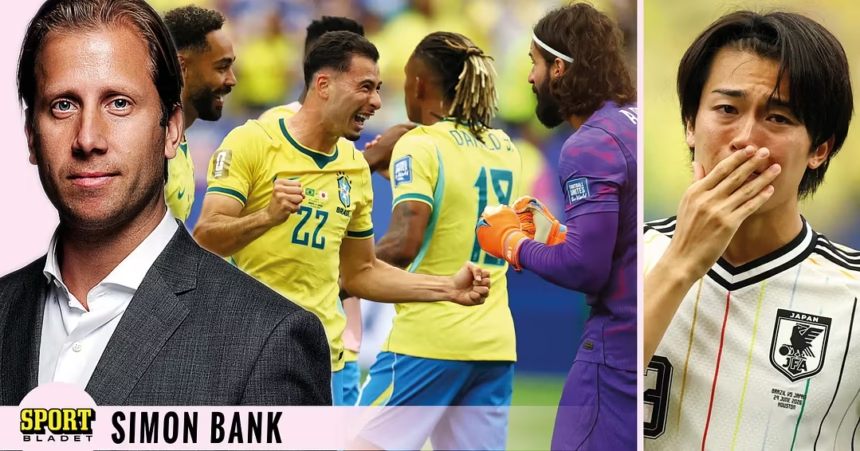


NEW JERSEY. For 40 years, Japanese football has strived to catch up with Brazil.
In the end, they were one second away.
It hurts so terribly to be close.
Half an hour had passed in one of the World Cup’s most titillating matches when the trap door was opened.
No one cheered when Danilo, 34, was selected as right-back in Brazil’s World Cup squad, but he himself saw it as a chance to put things right.
He has never really been able to let go of the exit against Croatia in the World Cup quarters four years ago, he has told about how he cried afterwards, how the loss lives in him as a trauma, an emotional wound.
It couldn’t get any worse, could it?
Hold my misty Asahi cup, Kodai Sano said.
The Japanese central midfielder read a Danilo pass as the entire Brazilian team was moving forward. A flowing fine and a fine finish later, Japan was knocking on heaven’s door.
1–0, against Brazil.
Not just any goal.

Sano received his first football education in a youth club back home in Okayama, a club named FC Viparte. The name is an amalgamation of two Portuguese words: far (life) and party (Start).
After all, Japanese football has long broken Brazilian Portuguese. Huge numbers of Japanese have emigrated to Brazil, just as many Brazilians have moved to Japan to (mostly) build up industry.
For the past thirty years, throughout the professionalization process of Japanese football, Brazilian players and coaches have been fundamental.
Brazilian players have become icons in the J-League, Brazilian coaches (Falcão, Zico) have led the national team. Their football has borrowed its playful passing game from Brazil.
Japan has been striving towards Brazil. Now they were a goal ahead with a half to play.
Japan were extremely well organized in their 5–2–3. Synchronized back line, constantly leaning forward and ready to take five steps to press, assist, ensure that no full back was left alone.
The job was done better than well
A cornerstone of Japanese culture is the belief that any job worth doing is also worth doing well.
They shut Brazil down, almost completely. Vini Jr was never able to find his way with the ball, when dangerous transition situations appeared, Japan took free kicks or even yellow cards, in order not to expose themselves.
The job was done, better than good.
Out by the bench Carletto Ancelotti stood in a three-piece suit, watching as his adopted brat from the years in Madrid toiled without coming to. With Neymar halfway to retirement and Raphinha injured, it’s time for Vini Jr to take over A Seleção.
His team, his WC.
Halfway through, the snitch Ancelotti raised an eyebrow and corrected the whole set-up. They didn’t run away from Japan, they didn’t play their way through Japan, so they had to try to force their way over Japan.
It is not classic Brazilian football, it is not a football to win audiences and trophies with. But here it was just about winning a match.
Crossing from the right, crossing from the left, making sure the central midfielders filled up. Lots of bodies in the penalty area
Bruno Guimarães nodded, Casemiro nodded, it was saved on the goal line and by the goalkeeper. Until Gabriel lifted a ball in and Casemiro got right. 1-1, half an hour to go.

There was only one team on the field
It wasn’t just a place in the round of 16 that was up for grabs. For Japan, it was about becoming better than their role models, putting into overdrive the development that will make them world champions, soon.
For Brazil, it was about survival, giving an aging squad (Endrick and Rayan are the only ones under 25, in the group stage the starting XI had an average age of over 30) a chance to grow another week.
In the last half hour it was no longer a match, there was only one team on the pitch – and that was Big Brother.
Vini Jr. tunneled into the stride, floated past a back and another, and hit an outside to the inside of the post. Paquetá broke, Casemiro too, but the bombardment just continued.
It all boiled down to that kind of moment that you love in America. Eye to eye, man to man, everything will be decided, winners and losers will be made.
And this time it wasn’t Danilo’s turn to cry. How far did the match clock tick? Four minutes stoppage time? Five?
Ao Tanaka, who had just come on, made a fatal error and gave the ball away instead of clearing. Bruno Guimarães found Gabriel Martinelli, who was clinical in the finish.
2-1, no seconds or power left for Japan.
One of the most defining moments of Japanese national football comes from 1993, when in the last second of qualifying they conceded a goal against Iraq, which meant they missed out on going to the World Cup for the first time.
This could have been something else, but it was the same kind. Tanaka cried after the final whistle. They’re closer now than they’ve ever been, they’re just not there yet.